
Test & Measurement Blog · 11 Sep 2026
Keysight Technologies Multimeter: Models, Specs and Calibration

Keysight’s bench multimeters are the Truevolt family: the 34460A, 34461A and 34465A at 6½ digits, and the 34470A at 7½ digits. Pick by basic DC voltage accuracy and reading rate, then keep the meter on a calibration schedule that matches the accuracy column you rely on (90 days, 1 year or 2 years in the data sheet). Keysight’s accuracy figures assume a 60-minute warm-up and a temperature within ±5 °C of the calibration temperature. The numbers here come from Keysight’s Truevolt 34460A/61A/65A/70A data sheet.
How do the Truevolt models compare?
| Specification | 34460A | 34461A | 34465A | 34470A |
|---|---|---|---|---|
| Digits | 6½ | 6½ | 6½ | 7½ |
| Basic DCV accuracy | 75 ppm | 35 ppm | 30 ppm | 16 ppm |
| Max reading rate | 300 rdgs/s | 1,000 rdgs/s | 50,000 rdgs/s | 50,000 rdgs/s |
| Memory | 1,000 rdgs | 10,000 rdgs | 50,000 rdgs, 2 million optional | 50,000 rdgs, 2 million optional |
| Measures | DCV/ACV 100 mV to 1,000 V / 750 V; resistance 2- and 4-wire; DCI/ACI; frequency 3 Hz to 300 kHz; continuity, diode, temperature | |||
All four measure capacitance from 1 nF to 100 µF. Thermocouple input is listed for the 34465A and 34470A, while the 34460A and 34461A cover RTD (Pt100) and thermistor temperature. LAN/LXI is optional on the 34460A and standard on the others, GPIB is optional on all four, and the 34460A has no rear input terminals, so check the interfaces if you plan to automate. A broader range, including the entry EDU34450A bench multimeter and handhelds such as the U1281A, sits below and beside these. Browse bench multimeters and handheld multimeters. To see how digits relate to accuracy, read our guide to the resolution of a multimeter.
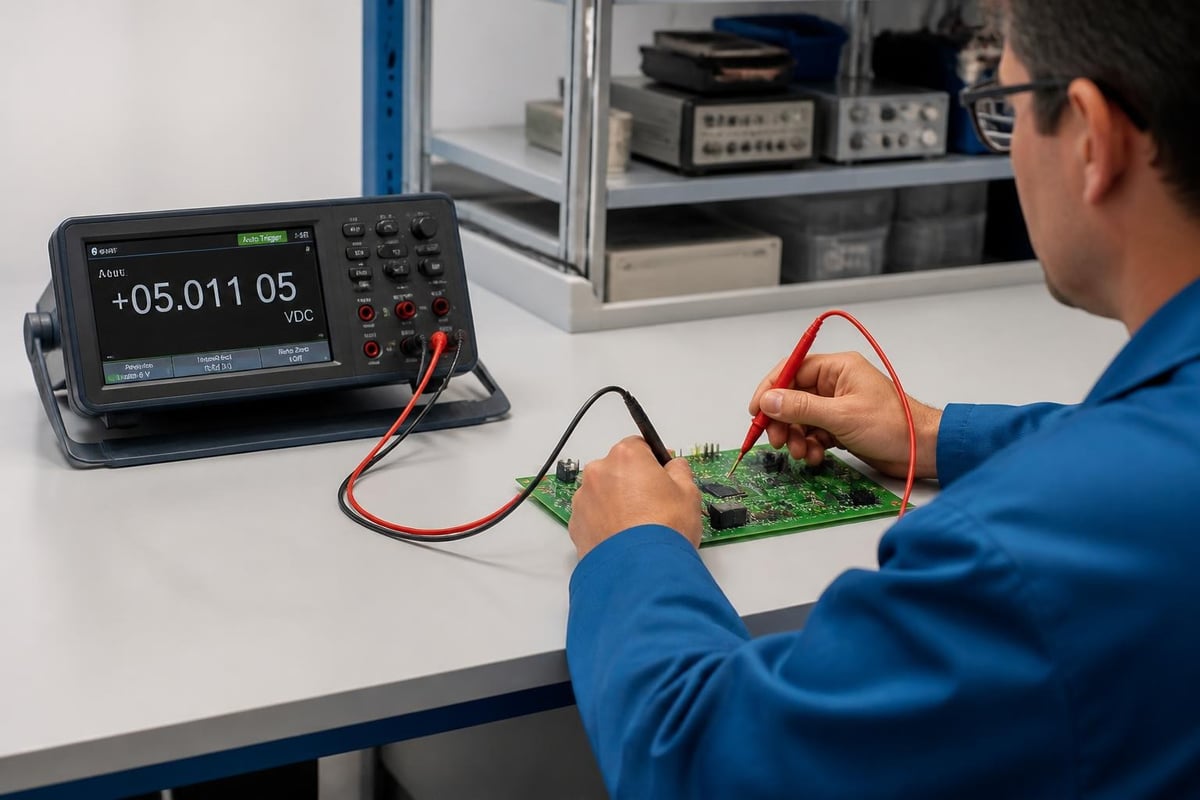
How do you read a Keysight accuracy specification?
Keysight writes accuracy as ±(% of reading + % of range), listed for 24 hours (within ±1 °C of the calibration temperature, TCAL), 90 days, 1 year and 2 years (within ±5 °C of TCAL). Outside that band, add the temperature coefficient for every degree C. The data sheet states the DC specifications assume a 60-minute warm-up, an aperture of 10 or 100 power line cycles and auto zero on, and that the specifications are compliant with ISO/IEC 17025 for k = 2.
Worked method, with illustrative numbers (take the real ones from the table for your model and range): a meter specified at ±(0.0035 % of reading + 0.0005 % of range) on its 10 V range, reading 10 V, has an error limit of 0.0035 % x 10 V + 0.0005 % x 10 V = 0.35 mV + 0.05 mV = ±0.40 mV. At 1 V on the same range the reading term shrinks to 0.035 mV, but the range term stays at 0.05 mV, so the error is ±0.085 mV, which is 0.0085 % of the reading. Always use the lowest range that holds the signal.
How often should the meter be calibrated?
The data sheet gives accuracy for 90 days, 1 year and 2 years, so the interval is your choice, as long as you use the matching column in your uncertainty budget. Many quality systems use one year. A longer interval means a wider specification limit, which weakens your test uncertainty ratio, and an as-found history showing that the meter stays well inside its limit can justify keeping the interval. Keysight also lists an auto calibration function that compensates temperature drift during the working day, which is separate from the traceable calibration with a certificate. Our article how often should instruments be calibrated covers interval review, and calibration equipment for ISO/IEC 17025 laboratories covers lab requirements.
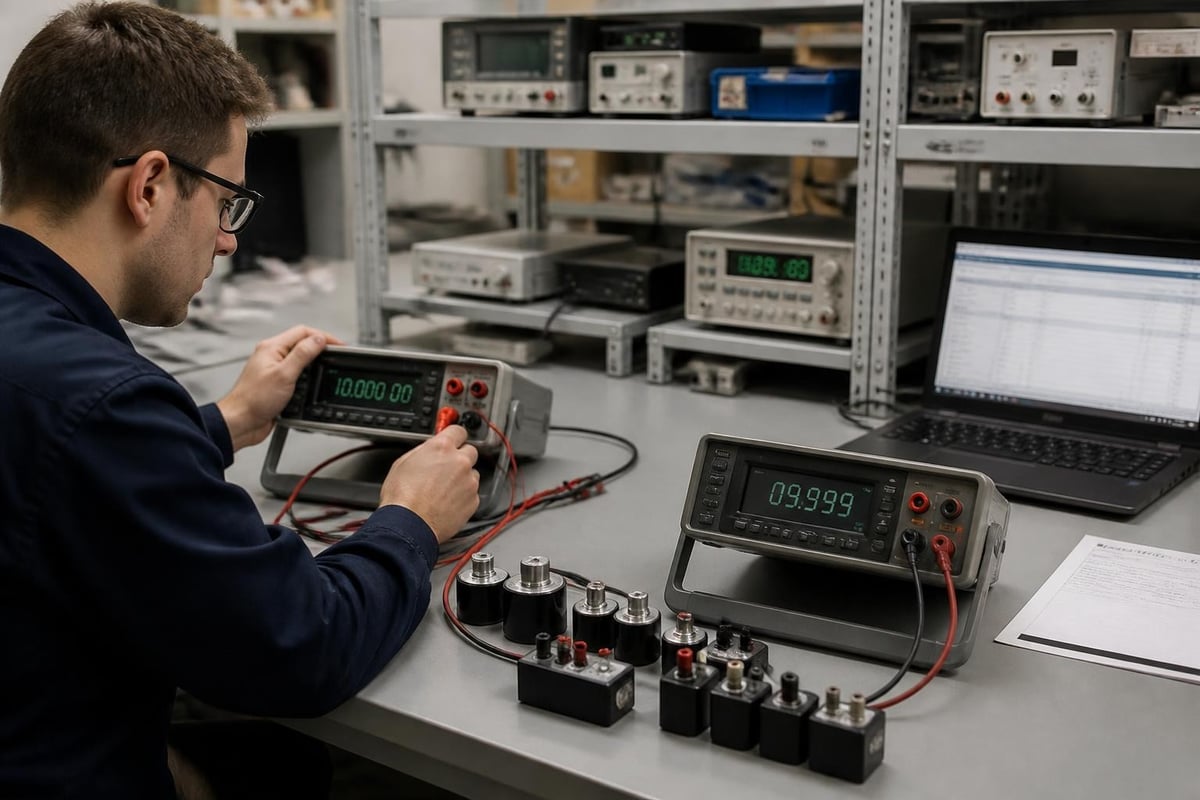
What does a calibration or verification include?
- Warm up the meter for at least the data sheet time (60 minutes) in the calibration lab’s stable temperature.
- Record the room temperature, to confirm you are inside TCAL ± 5 °C.
- Apply a traceable DC voltage source or multifunction calibrator at zero, mid and full scale on each range, and record the errors.
- Repeat for AC voltage at several frequencies, DC and AC current, and resistance in four-wire mode.
- Compare the errors with the specification limit for your interval, and apply an adjustment only when needed.
- Issue a certificate with as-found and as-left data and the uncertainty with k = 2.
The reference should be much better than the meter. A 4:1 ratio is common, so verifying a meter with a 0.40 mV limit at 10 V (as in the example above) needs a source with an uncertainty at or below roughly 0.1 mV, and a tighter meter such as the 34470A needs a source better still.
Why use four-wire resistance?
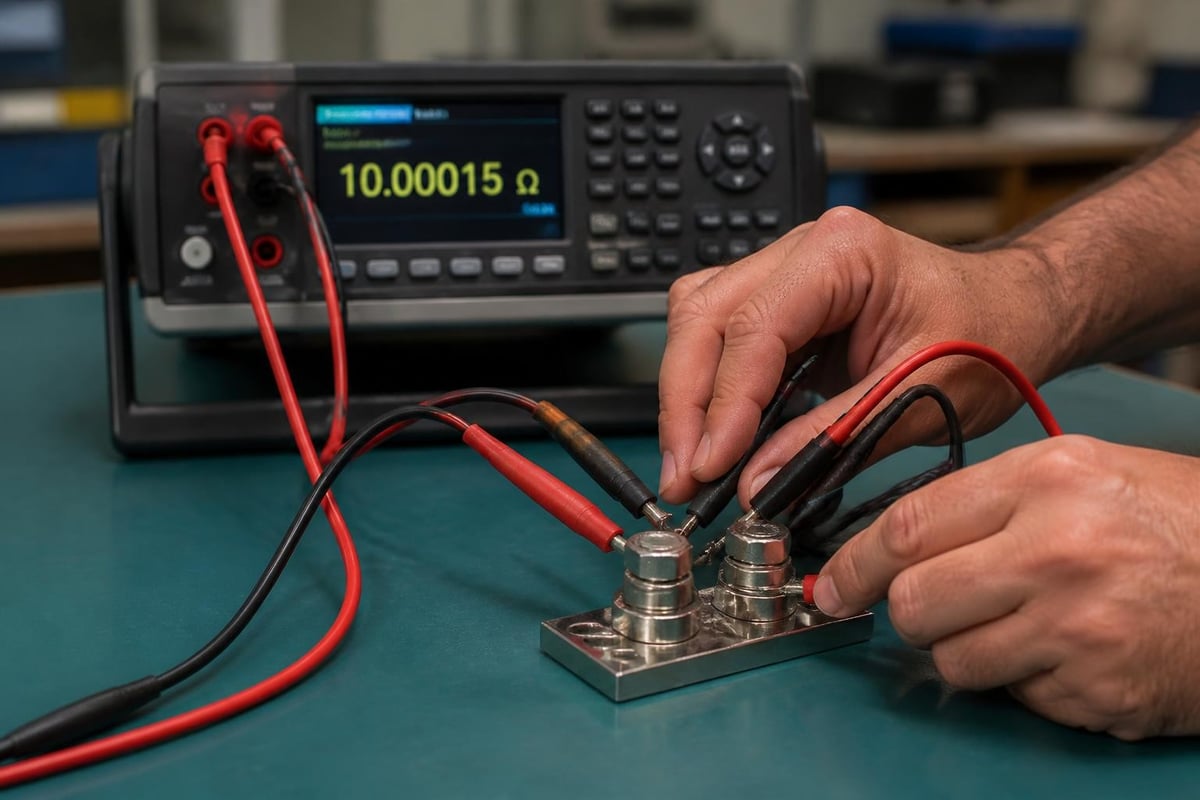
Two-wire measurements include the lead and contact resistance in the reading. Four-wire measurement drives the test current through one pair of leads and senses the voltage on a second pair, which removes the lead error. Keysight’s resistance specifications are stated for the four-wire function, or for the two-wire function with the math null function used to remove the offset, and without null extra error must be added (see the notes in the data sheet).
What goes into the uncertainty budget?
- The specification limit of the meter for the range, function and interval (divided by √3 if treated as a rectangular distribution).
- The reference’s calibration uncertainty and its drift.
- Temperature outside TCAL ± 5 °C (coefficient times degrees).
- Repeatability of the readings and the noise at the chosen aperture.
- Connection effects: thermal EMF, lead resistance, loading and settling.
Combine by root sum of squares and expand with k = 2. The principles are in the BIPM Guide to the expression of uncertainty in measurement. For the wider lab picture, see what to look for in a measurement company.
What other test and calibration tools go with it?
A DMM is one part of a calibration bench. Pressure work needs a pressure standard such as the Mensor CPC4000 pneumatic pressure calibrator and a pump like the Additel ADT946A. For bench work with a scope, read the Keysight scope calibration guide.
The Keysight Technologies 34460A digital multimeter is listed in our catalogue. Browse the full range of test and measurement instruments. Sales terms are on the returns and warranty policy page.
IndoMultiMeter ships worldwide.
Frequently asked questions
Which Keysight Truevolt multimeter should I buy?
Choose by accuracy and speed. The 34460A is 6½ digits at 75 ppm basic DCV accuracy and 300 readings/s. The 34461A is 35 ppm and 1,000 readings/s. The 34465A is 30 ppm at up to 50,000 readings/s. The 34470A is 7½ digits at 16 ppm.
What does basic DCV accuracy of 35 ppm mean?
It is Keysight’s headline 1-year DC voltage figure for the 34461A, equal to 0.0035 %. The full specification is split into a percent of reading term and a percent of range term for each range, so use the table for the range you actually measure on.
Do Keysight multimeters need a warm-up?
Yes. The data sheet DC and AC specifications assume a 60-minute warm-up. Measure on a stable bench and record the temperature, since the accuracy columns apply within ±5 °C of the calibration temperature.
Is auto calibration the same as a calibration certificate?
No. Auto calibration compensates temperature drift during use. A calibration certificate comes from a traceable calibration with a reference standard and an uncertainty statement.
Why use four-wire resistance on a DMM?
Four-wire measurement removes the lead and contact resistance from the reading. Keysight specifies resistance for the four-wire function, or for two-wire with math null applied.