
Test & Measurement Blog · 30 Aug 2026
Scope Keysight: Calibration, User Cal and Bandwidth Guide
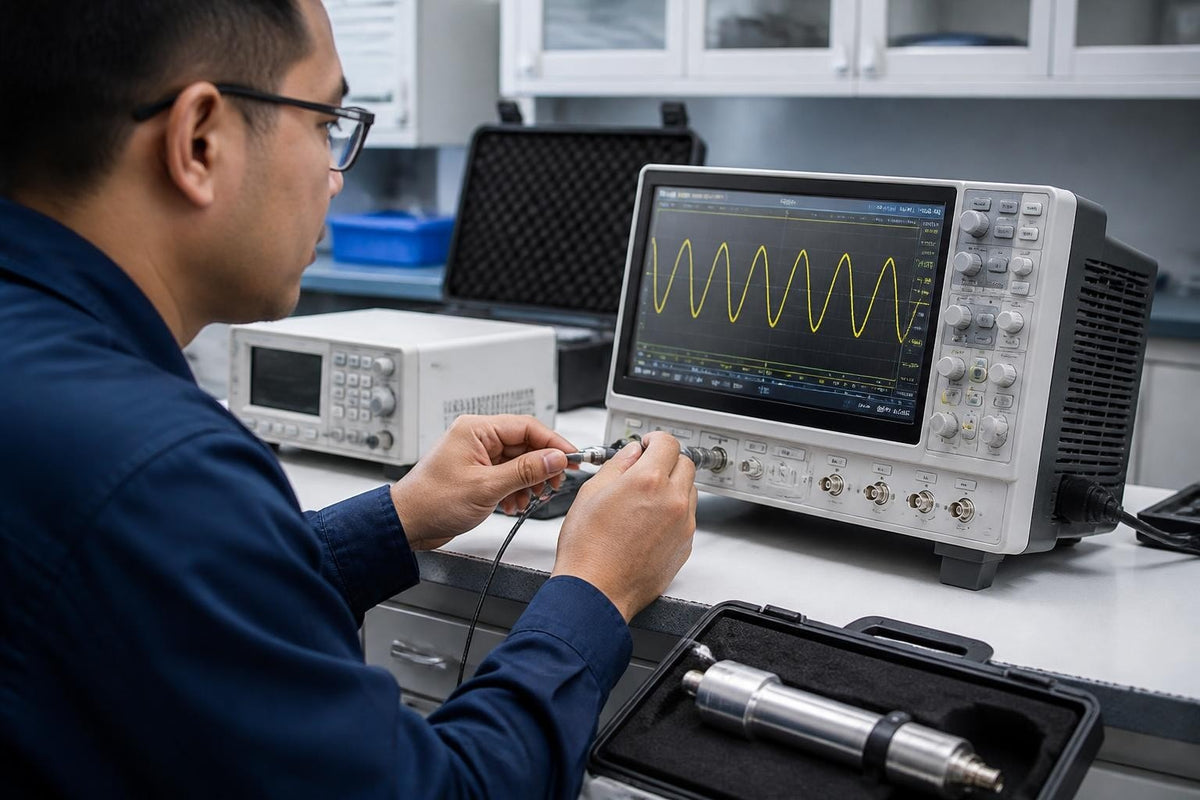
A Keysight scope needs three different things to stay accurate: a quick User Cal (self-alignment) when the temperature or hours of use call for it, a periodic performance verification or calibration against traceable sources, and routine probe compensation before use. User Cal optimises the signal path with internal signals, but Keysight states that performing it invalidates the Certificate of Calibration, so it does not replace a traceable calibration. The details below come from Keysight’s InfiniiVision 2000/3000 X-Series Service Guide (June 2013 edition). Other families differ, so check the guide for your model.
Which Keysight scope family and bandwidth do you need?
| Family | Typical bandwidth range | Typical use |
|---|---|---|
| InfiniiVision 1000 X | up to 200 MHz with upgrades | Education, bench debugging |
| InfiniiVision 2000 X | 70 to 200 MHz | Bench debugging, embedded work |
| InfiniiVision 3000T X | 100 MHz to 1 GHz | General-purpose and mixed-signal work |
| InfiniiVision 4000 X | 200 MHz to 1.5 GHz | Higher-speed digital and mixed-signal |
| InfiniiVision 6000 X | 1 to 6 GHz | High-speed design |
| Infiniium | 500 MHz to 63 GHz | Signal integrity, serial data, RF |
The bandwidth ranges for the InfiniiVision families come from a reseller comparison table, and bandwidths on some models are software upgradable, so confirm the current figure on the Keysight data sheet. Keysight’s own oscilloscope selection tips give three simple rules:
- Analog signals: bandwidth at least 3 times the highest sine frequency.
- Digital signals: bandwidth at least 5 times the highest clock rate. A 100 MHz clock calls for 500 MHz or more.
- Sample rate at least 4 to 5 times the real-time bandwidth.
For the theory, read oscilloscope bandwidth explained. To choose between two entry models, see Keysight 1000 X vs 3000A X.
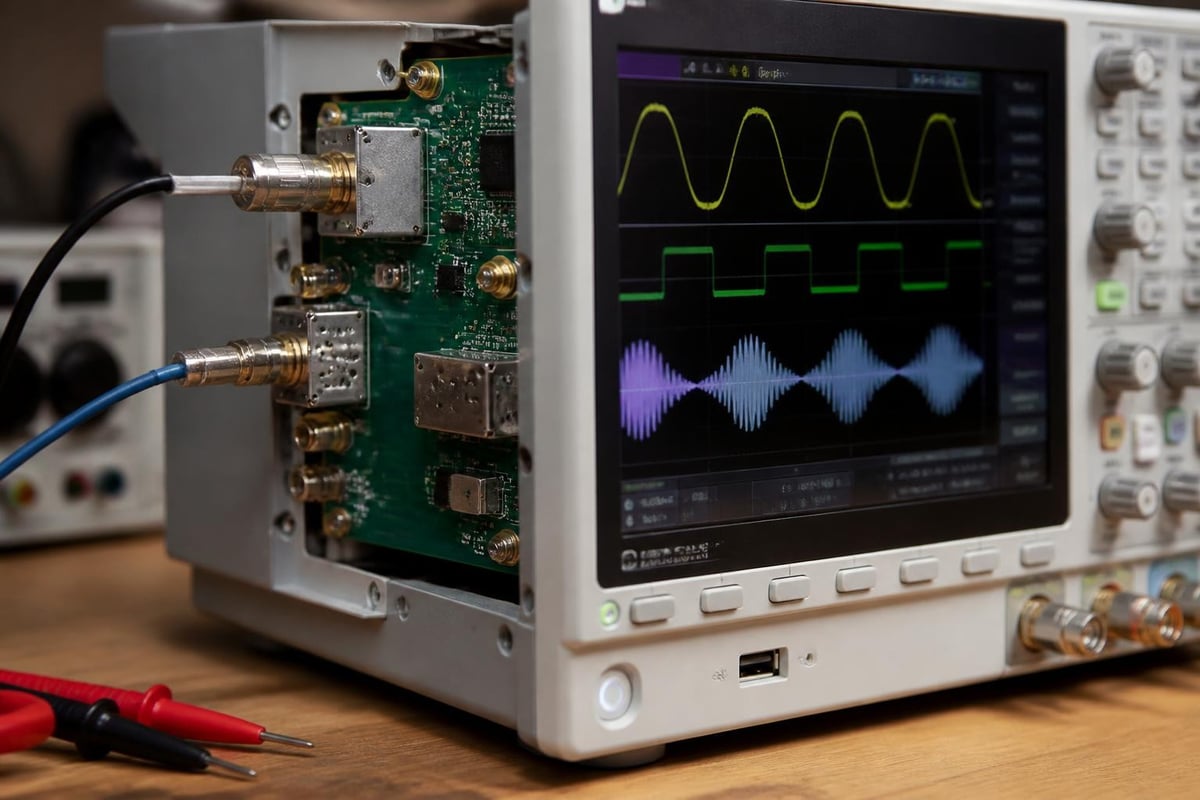
What does a bandwidth rating mean for your readings?
Bandwidth is the frequency at which a sine wave is displayed 3 dB down, which is 70.7 % of its true amplitude. A 100 MHz scope therefore shows a 100 MHz sine of 1.00 V peak as only about 0.71 V. That is a 29 % error from the scope bandwidth alone, and it is the reason for the 3x and 5x rules above. At one third of the bandwidth the roll-off is small, but it is not zero.
How do you run User Cal on a 2000/3000 X-Series scope?
Keysight says to perform User Cal every two years or after 4,000 hours of operation, when the ambient temperature is more than 10 °C away from the temperature at the last calibration, and whenever you want maximum accuracy. More use or harsher conditions may justify shorter intervals. The procedure, from the guide:
- Disconnect all inputs, including the digital cable on an MSO, and let the scope warm up.
- Press the rear-panel CAL button to disable calibration protection.
- Connect short, equal-length 50 ohm RG58AU or equivalent BNC cables from each analog channel to a BNC tee and barrel connector arrangement, as the guide shows for 2- and 4-channel models.
- Connect a BNC cable of at most 40 inches from the rear TRIG OUT to the barrel connector.
- Press [Utility], then Service, then Start User Cal.
The User Cal Status screen shows the date, the temperature change since the last User Cal, and any failure. The guide also says that if a performance test fails, perform User Cal first and repeat the test. If NIST traceability is required, use the traceable test procedure in the guide instead.
What does a full performance verification include?
The 2000/3000 X guide lists these tests: DC vertical gain accuracy, dual cursor accuracy, bandwidth (-3 dB), time base accuracy and trigger sensitivity, with a 30-minute warm-up before testing. The listed equipment includes an oscilloscope calibrator (Fluke 5820A), a precision multimeter, a signal generator and a power meter with sensor. For the 3000 X-Series, the DC vertical gain test limit is ±2.0 % of full scale.
Full scale is 8 divisions times the V/div setting. At 1 V/div that is 8 V, so the limit is ±0.16 V. A 2 V signal read on that range may be off by up to 8 % of the reading, while the same signal on a 500 mV/div range, where full scale is 4 V, is limited to ±0.08 V. Choose a V/div setting that fills the screen to get the best accuracy.
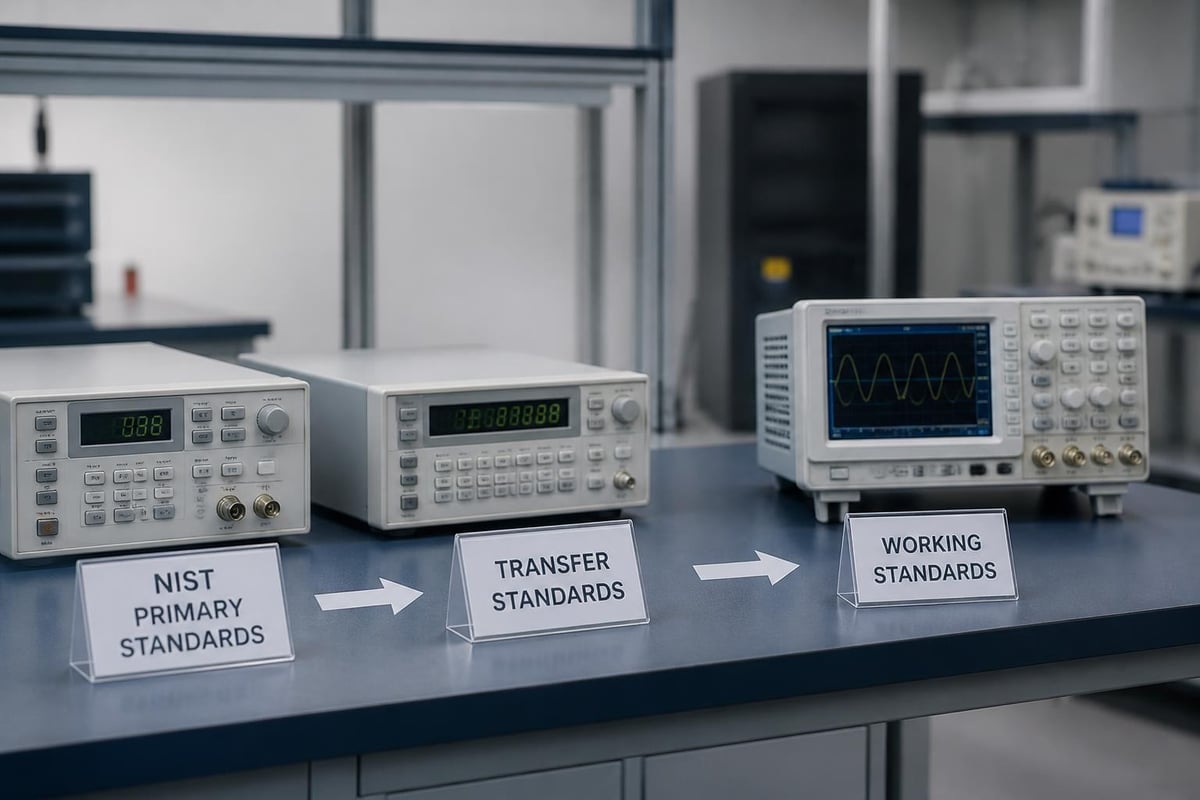
An accredited laboratory runs these tests with traceable standards, states the uncertainty and issues a certificate, which is what you need for a quality system. Read calibration, verification and adjustment for how the terms differ, and how to choose calibration tools for industrial engineers for related equipment.
What are the environmental limits?
For the 2000/3000 X-Series, Keysight specifies indoor use only, an operating temperature of 0 to +55 °C, and operating humidity up to 80 % RH at or below +40 °C, falling to 45 % RH up to +50 °C. The scope may be used in Pollution Degree 2 environments, where condensation can occasionally cause temporary conductivity. Keep it out of condensing conditions, warm it up before a calibration, and note the temperature at the time of each calibration. The measurement category is I, so it is not for direct measurements on mains. See the guide for the transient withstand and overvoltage category.
What should you check before each session?
- Compensate each probe on the scope’s own calibration output. Our guide to how to compensate an oscilloscope probe walks through it.
- Set the probe attenuation (1x or 10x) in the channel menu so the scale matches.
- Keep ground leads short for fast edges and check that the bandwidth of the probe suits the scope. Browse oscilloscope probes for matched options.
- Let the scope warm up before comparing against a precise reference.
- Look at the User Cal Status screen for the temperature change since the last User Cal.
What else does a modern Keysight scope add?
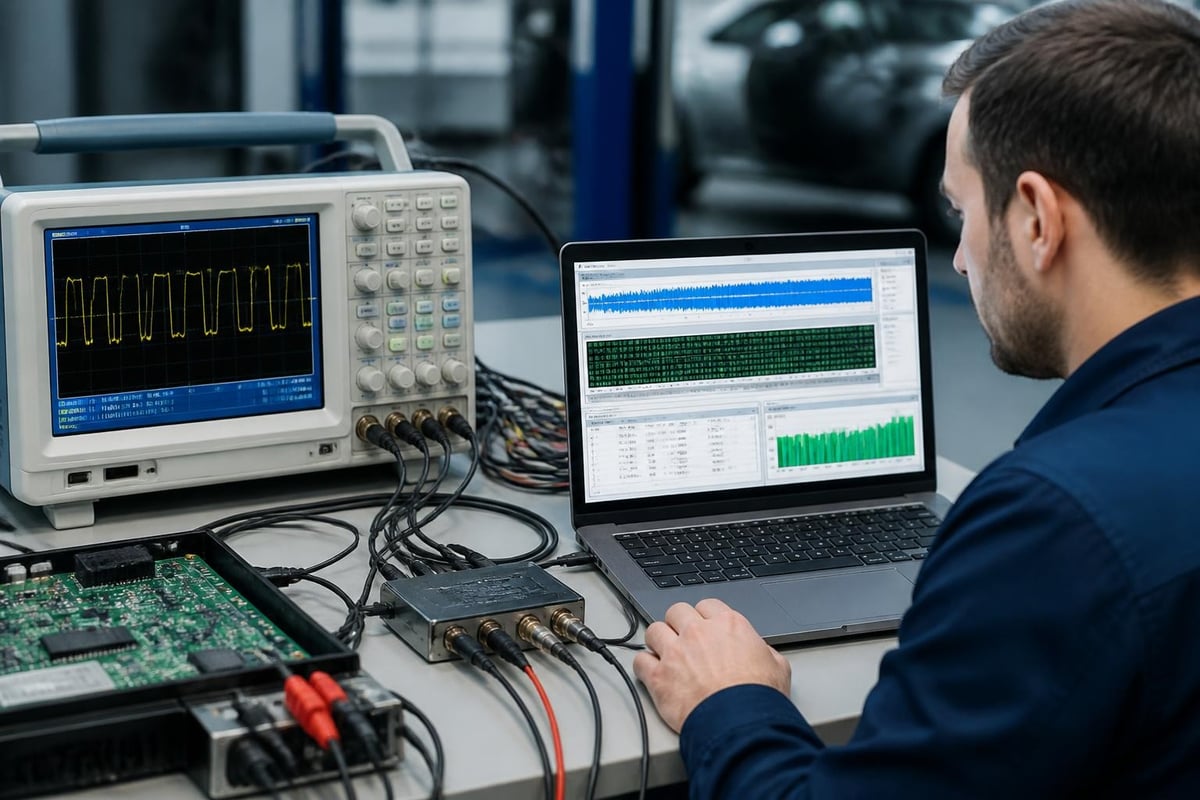
Keysight describes the InfiniiVision 3000T X-Series as a 7-in-1 instrument with an 8.5-inch capacitive touch screen, a waveform update rate of 1 million waveforms per second, a wide range of serial decodes and built-in USB host and device ports (see the 3000T X-Series data sheet). Those functions all rely on the same acquisition accuracy, so the calibration steps above apply regardless of how many decoders you use.
Where can you find Keysight scopes and related test equipment?
Browse digital oscilloscopes, for example the Keysight DSOX1204G 100 MHz 4-channel scope with waveform generator, the DSOX3014G 100 MHz 4-channel scope and the Infiniium S-Series DSOS054A 500 MHz scope. Related instruments are in electrical test, temperature and thermal, thermal imaging, pressure calibrators and temperature calibration equipment.
See the full range of test instruments at IndoMultiMeter. Orders ship worldwide.
Frequently asked questions
How often should a Keysight oscilloscope be calibrated?
For User Cal on the 2000/3000 X-Series, Keysight says every two years or after 4,000 hours, or when the ambient temperature is more than 10 °C from the last calibration. For traceable calibration, follow your quality system, commonly an annual interval, and check your model’s service guide.
Does User Cal replace a calibration certificate?
No. Keysight states that performing User Cal invalidates the Certificate of Calibration. If NIST traceability is required, run the performance procedure with traceable sources or send the scope to a calibration laboratory.
How much bandwidth do I need?
Keysight recommends at least 3 times the highest sine frequency for analog work, and at least 5 times the highest clock rate for digital work. For a 100 MHz clock, that means 500 MHz or more.
Why does my signal look smaller at high frequency?
Bandwidth is defined at the -3 dB point, where a sine is shown at 70.7 % of its true amplitude. A 100 MHz sine of 1 V peak on a 100 MHz scope reads about 0.71 V. Use a scope with several times more bandwidth than the signal.
What does the DC gain accuracy specification mean?
On the 3000 X-Series the test limit is ±2.0 % of full scale, with full scale defined as 8 divisions times the V/div setting. At 1 V/div that is ±0.16 V, so set a V/div that fills the screen.