
Test & Measurement Blog · 25 Aug 2026
Dry Block vs Calibration Bath: How to Choose a Temperature Calibrator
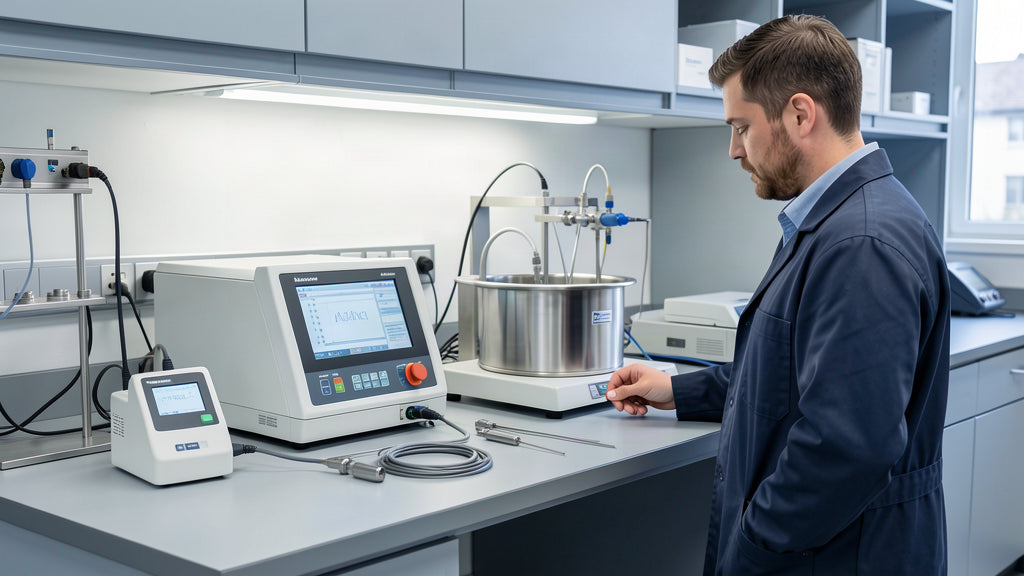
Temperature sensors such as RTDs, thermocouples and dial thermometers drift over time because of thermal stress, vibration and the environment. To keep them accurate you compare them against a traceable reference in a stable temperature source. The two main choices are a dry block calibrator (also called a dry well) and a liquid calibration bath, and the right answer depends on where you work, how accurate you need to be and what shape your sensors are.
Quick answer: choose a dry block for field work, speed and portability. Choose a calibration bath for the best stability and uniformity, for odd-shaped sensors, and for target uncertainty below about 0.1 °C. Many teams use both: baths in the lab, dry blocks in the field.
How a Dry Block and a Calibration Bath Work
Dry block calibrators
A dry block heats or cools a metal block with drilled holes. The sensor under test goes into an interchangeable metal insert with a matching hole size, so it sits in direct thermal contact with the block. You bring the block to each test temperature, let it settle and compare the sensor reading with a reference. Dry blocks are compact, light and quick to reach temperature, and a typical unit holds one to three sensors at a time. Never pour oil or any other liquid into a dry well. It can create fumes, damage the heaters and void the warranty, unless the manufacturer sells a dedicated micro-bath insert.
Calibration baths
A calibration bath holds a stirred fluid, such as water, silicone oil, methanol or ethanol depending on the temperature range, which is heated or cooled to each test point. The fluid touches the whole sensor and constant stirring keeps the temperature very uniform. Baths accept long probes, complete assemblies and odd shapes that do not fit a drilled block, which is why they are the workhorse of temperature calibration labs.
Dry Block vs Calibration Bath at a Glance
| Feature | Dry block calibrator | Liquid calibration bath |
|---|---|---|
| Best for | Field and plant-floor checks | Lab and bench calibration |
| Portability | High: light, clean, no fluid to spill | Low: heavy, holds hot or cold fluid |
| Typical range | Roughly −95 °C to 700 °C for most dry blocks and metrology wells; furnace-type units go to 1200 °C | Roughly −100 °C to 550 °C, but each fluid covers only part of that range |
| Uniformity | Good: axial uniformity of about ±0.05 °C to ±0.2 °C on a high-end dry well | Excellent: a stirred fluid gives the best uniformity and stability |
| Speed | Fast heat-up and cool-down | Slower because of the fluid mass |
| Sensor shape | Straight probes that fit the insert | Almost any shape or length |
| Sensors at once | One to three | Many at the same time |
| Cleanliness | No fluid residue | Probes need cleaning afterwards |
Accuracy, Stability and Uniformity
This is the core of the decision. A stirred bath has the same temperature throughout the working volume and very little fluctuation over time, so it beats a dry block on stability and uniformity. In a dry block the sensor is heated through the walls of a drilled hole, so gradients exist between the block centre and the hole wall and the temperature varies with insertion depth.
A practical rule of thumb: if your target uncertainty is below roughly 0.1 °C, choose a bath. If portability and speed matter more than the last few thousandths of a degree, choose a dry block.
Sensor Size, Shape and Immersion Depth
Dry blocks need the right insert for each probe diameter and suit straight probes of modest size. Baths take anything that fits in the tank, including long RTDs, thermocouple assemblies and glass thermometers. Immersion depth matters for both: a common guideline is a minimum immersion of 15 times the sensor diameter plus the length of the sensing element. If the probe is too shallow, heat conducts along the stem and skews the reading. Inspect inserts for wear, because a worn insert makes poor thermal contact and quietly degrades accuracy.
When to Choose a Dry Block Calibrator
- Technicians carry the unit to process skids, offshore platforms or across a refinery.
- Food, beverage and pharmaceutical areas where fluids are not acceptable near production.
- Temperatures above what common bath fluids can reach.
- Fast multi-point runs in a single shift.
When to Choose a Liquid Calibration Bath
- Short, curved, flanged or sanitary tri-clamp sensors that cannot make good contact in a dry well insert.
- Accredited or high-accuracy laboratory work, for example under ISO/IEC 17025.
- Batch calibration of many sensors with identical thermal exposure.
- Stability and uniformity requirements tighter than a dry block can deliver.
How to Compare Specifications
- Stability is how much the temperature moves over time at one point. Baths usually win.
- Uniformity (gradient) is how temperature varies across the working volume. For dry blocks, ask about radial gradient (centre to hole wall) and axial gradient (along the well depth).
- Display accuracy matters only when you use the calibrator without an external reference thermometer.
- Heat-up and settling time drives field productivity. A block that settles in minutes beats one that takes half an hour.
Also check the specification over your real operating range, not only the best-case figure at 23 °C ambient.
Reference Thermometers and Traceability
The block or bath is only a stable source of temperature. For documented calibrations, put a calibrated reference thermometer with a precision readout next to the device under test, so traceability runs from the reference certificate to national standards. The calibrator itself should also be calibrated on a regular cycle, commonly once a year, adjusted by its drift history and your quality system.
Choosing Bath Fluids and Working Below Zero
No single bath fluid performs well across a bath’s whole range. A bath covering roughly −45 °C to 150 °C, for example, typically uses ethanol below 0 °C and silicone oil above it, so laboratories needing a wide range often change fluids or keep more than one bath. For sub-zero work both technologies exist, but the fluid in a bath transfers heat better at low temperatures, whereas dry blocks rated for low temperatures are usually larger and slower to stabilise.
Looking After Dry Block Inserts
Most manufacturers offer interchangeable inserts, from standard round holes to multi-hole and custom bores, so one dry block can handle several probe diameters. Keep the inserts you actually use in the carrying case and inspect them for wear. A worn insert makes poor thermal contact and quietly degrades accuracy, even when the block itself is in perfect condition.
Matching Technology to the Work
- Field work: a portable dry block travels well, reaches temperature quickly and covers the one-to-three sensor checks typical of maintenance work on thermocouples and RTDs in process plants.
- Lab and workshop: a bath earns its place when accuracy targets tighten, sensor shapes vary or throughput matters. A bath plus a good reference thermometer is the standard setup for labs that certify sensors or work to tight uncertainty budgets.
- Metrology-level work: high-end stirred baths reach stability of a few thousandths of a degree, which is the territory of primary temperature standards and beyond what even the best dry wells can match for uniformity.
Quick Selection Checklist
- Need on-site portability: dry block.
- Working in clean or sanitary areas: dry block.
- Working above the range of bath fluids: dry block.
- Calibrating short, flanged or odd-shaped probes: calibration bath.
- Need lab-grade stability and uniformity: calibration bath.
Calibration Guidance and Listed Dry Blocks
EURAMET lists Calibration Guide No. 13, “Guidelines on the Calibration of Temperature Block Calibrators” (version 4.0, 09/2017), in its calibration guidelines. If you send a dry block to a laboratory, ask which method it follows and what uncertainty it reports.
Dry blocks and dry-wells listed on this site include the Fluke Calibration 9142-DW-156 (-25 to 660 °C), the Additel ADT878-160 reference dry well (-40 to 160 °C) and the Druck DRYTC650 (room temperature to 650 °C).
Next Step
Browse temperature calibrators for dry blocks and dry wells, temperature baths and chillers for lab-grade stability, and temperature measurement for reference thermometers and probes. Bath examples in our range include the Techne FBCAL07D liquid calibration bath and the Fluke Calibration 6109A-156 portable calibration bath.
Send your temperature range, accuracy target and whether the work is field or lab to info@indomultimeter.net or request a quotation, and we will recommend a dry block, a bath or a combination.