
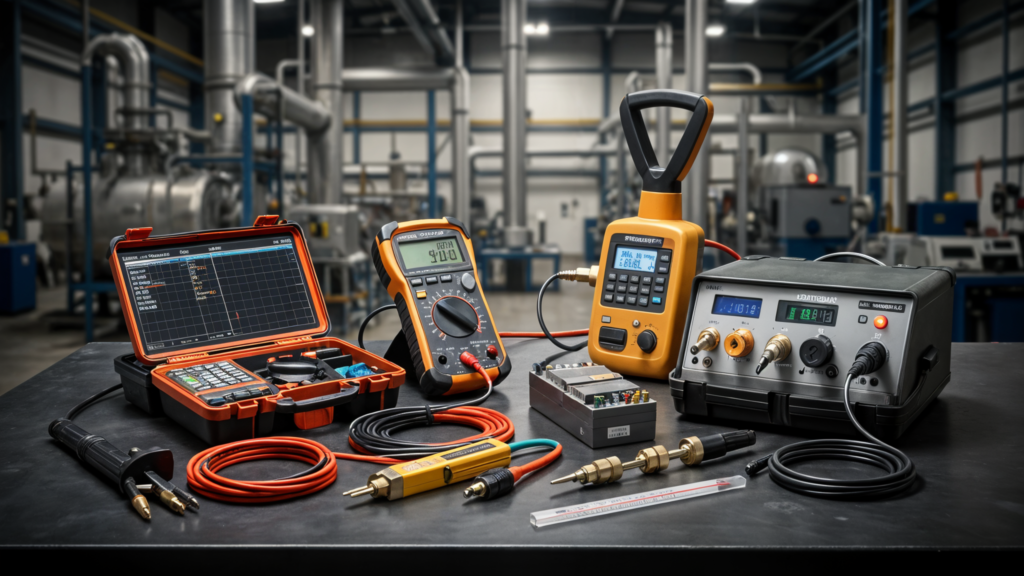
A field calibration technician’s toolkit is not a luxury — it is the difference between a calibration that takes ten minutes and one that takes all day, and between results you can defend and results you cannot. The calibration technician tools in a well-built kit cover electrical, loop, pressure, and temperature work, plus the documentation that turns raw readings into audit-ready records. This guide walks through what belongs in a field calibration kit and why each piece earns its place.
The Kit by Function
Electrical and Loop Tools
- Digital multimeter. The foundation tool for continuity, voltage, and basic current checks. Choose a CAT-rated meter appropriate for the electrical environment you work in — plant work around energized equipment demands a meter rated for that category.
- Loop calibrator. Sources and measures 4–20 mA, reads percent of span, and supplies loop power. This is the tool for loop troubleshooting and transmitter output checks — the most common calibration job in process plants.
- HART communicator or documenting calibrator. For smart transmitters, you need digital access: read the process variable, perform digital trims, and change configuration. A communicating calibrator combines this with process calibration in one device.
Pressure Tools
- Pressure calibrator with hand pump. Generates test pressures and measures the result — the core of transmitter and switch calibration.
- Pressure modules. Interchangeable ranges extend one calibrator across vacuum, low pressure, and high pressure without carrying multiple complete instruments.
- Deadweight tester. The high-accuracy reference for critical work, most often found in labs and metering areas rather than in the daily field kit.
- Digital pressure gauge. A fast, accurate cross-check for field work when you want a second reference or a direct reading.
Temperature Tools
- Portable dry block calibrator. The field workhorse for RTD and thermocouple calibration, with interchangeable inserts for different probe diameters.
- Reference thermometer and readout. For documented temperature calibrations, a calibrated reference with a precision readout is what makes the results traceable.
Support and Documentation
- Calibration software or laptop for downloading results, generating certificates, and keeping records.
- Test leads, clips, and adapters — spare leads, alligator clips, banana plugs, and pressure fittings (NPT, BSP, metric) for connecting to whatever the plant throws at you.
- Labels and tags for marking calibrated instruments, with as-found and as-left status.
- Spare batteries, chargers, and cleaning supplies — field kits die from dead batteries and dirty connectors more than anything else.
Why Each Tool Earns Its Place
Every tool in the kit exists to compress a workflow. Consider a routine pressure transmitter calibration: the pressure calibrator and pump generate the reference pressure, the calibrator’s mA function measures the transmitter output, and the HART communicator performs the trim and reads the process variable. Without any one of these, the job stalls or requires a second trip to the truck.
One detail that separates good loop work from guesswork is percent of span. When you check a transmitter, you are not just looking at milliamps — you want to know how the output compares to the expected value at each test point. Loop calibrators display mA as percent of 4–20 mA span, so a reading of 12 mA at the 50 percent test point shows up immediately as 50.0 percent, and drift shows up as a deviation you can record and act on.
Pressure switches deserve their own mention. Testing a switch means slowly increasing pressure until the switch actuates, recording the set point, then decreasing to find the deadband. A pressure calibrator with a pump and a continuity function is all you need, but the procedure requires a steady hand and a slow approach — a fast pump stroke overshoots the set point and gives a false reading. Good technicians develop a feel for it, and it is one of the most common jobs in a field calibration day.
The reference tools matter most of all. Calibration is a comparison — the device under test against a reference of higher accuracy. If the reference in your kit is not properly calibrated and traceable, every result you produce inherits its error, and you will not know it until an auditor or a process upset asks questions. Field references should be on a documented calibration schedule against the plant’s lab standards.
Intrinsically Safe and Hazardous Area Considerations
In plants with classified areas, the kit must match the area classification. Instruments used inside hazardous areas need appropriate ratings — intrinsically safe or approved for the zone or division in use. This is not a specification detail; it is a permit-to-work requirement in most facilities. If your plant has classified areas, confirm the ratings of every electronic tool in the kit before you take it inside, and keep intrinsically safe tools separate from general-purpose tools. A non-rated multimeter opened inside a classified area is a serious safety and compliance issue, regardless of how careful the technician is.
Keeping the Kit Ready
A field kit is a system, and systems need maintenance. Practical habits that pay off:
- Check calibrator battery charge and function before every shift — a dead calibrator in the field is a lost day.
- Keep pressure fittings clean and capped; a burred fitting wastes time and leaks pressure at the worst moment.
- Store sensors and reference thermometers in their cases, away from vibration and heat.
- Review calibration due dates on your own references weekly — your tools are only as good as their latest certificate.
- At the end of each job, download documenting calibrators and file the results; records that stay in the instrument help nobody.
From Readings to Records
Documentation is part of the kit, not an afterthought. Modern documenting calibrators store as-found and as-left results on the job, and calibration software turns them into reports and certificates without re-typing. If your team still records results by hand, consider whether the kit is saving time or costing it: a documenting workflow pays for itself in audit hours alone.
Calibration Technician Tools: Manufacturer Resources
When selecting calibration technician tools, start with the manufacturer specifications, safety approvals, accuracy statements, and published operating limits. These official resources are useful starting points for comparing equipment:
- Fluke Calibration tools for precision electrical, pressure, temperature, and multifunction calibration solutions.
- Additel pressure calibrators for portable and automatic pressure calibration applications.
- FieldComm Group HART resources for the HART communication protocol and registered-product information.
Always confirm the exact model specifications, hazardous-area approvals, accessories, and current calibration requirements in the manufacturer documentation before purchase or field use.
Building Your Field Calibration Kit
Start with the jobs you actually do. A technician whose work is 80 percent loop and transmitter calibration needs a loop calibrator, a HART-capable tool, and a pressure setup first; a technician covering temperature sensors adds a dry block and reference thermometer. Build the kit around your instrument list, then add depth:
- Calibration instruments — the core references and multi-function calibrators.
- Loop calibrators — for 4–20 mA source, measure, and loop power.
- HART communicators — digital access to smart transmitters.
- Pressure calibrators and pressure modules — complete pressure test systems.
- Temperature calibrators — dry blocks for field temperature work.
- Multimeters and electrical test instruments — including megohmmeters and insulation testers for motor and cable checks during commissioning.
Buying once and buying right matters here: the tools in this kit are used daily, in weather, around chemicals, and inside vessels. A robust, well-supported calibrator costs more up front but outlasts and outperforms cheap alternatives — and its calibration history stays clean, which is what audits check.
Outfit Your Technicians
A complete kit — calibrated references, the right communicators, spare fittings, and documentation tools — is what turns a good technician into a fast, defensible one. Tell us your instrument list and typical jobs, and we will help you spec a kit that covers them. Request a quotation for individual tools or complete technician kits.
Editorial note: This guide was prepared by the Indo Multimeter Editorial Team for engineers and technicians researching test, measurement, and calibration equipment. Specifications and application guidance should be checked against the manufacturer documentation and the requirements of your calibration procedure.