
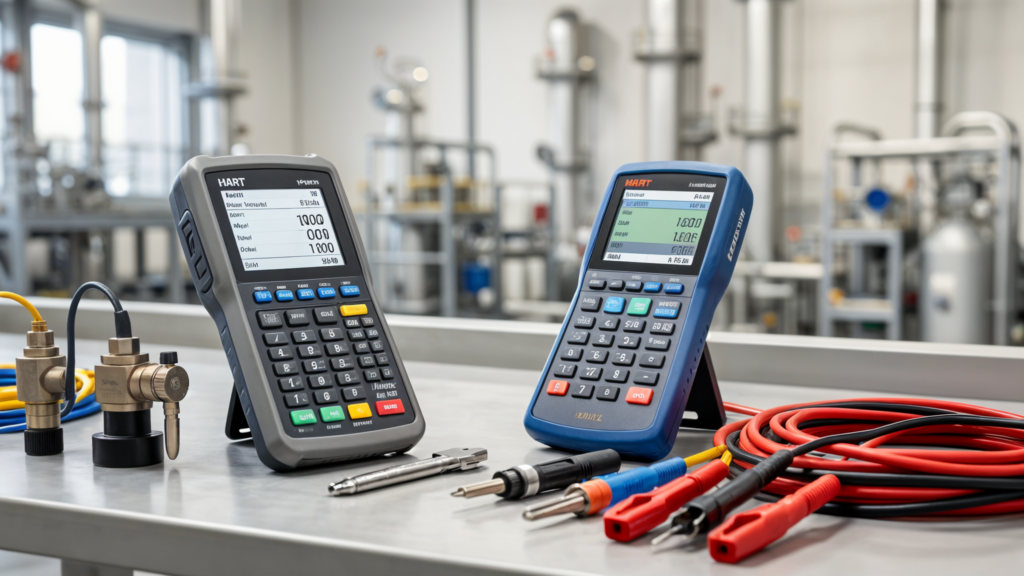
HART communicator price depends on whether you need basic device configuration, full documenting calibration, pressure measurement, or a broad transmitter device library. This guide compares the Fluke 754, Fluke 725, and practical alternatives so maintenance and calibration teams can compare like-for-like quotations.
HART Communicator Price: What You Are Paying For
HART (Highway Addressable Remote Transducer) is a digital communication protocol superimposed on the conventional analog 4-20 mA loop. A HART communicator talks to smart transmitters over the same two wires that carry the analog signal, which means a technician can communicate with an installed instrument without breaking the loop.
Typical tasks include reading process variables digitally, changing range and configuration, trimming zero and span, checking diagnostic and status information, and performing loop tests. For plants with HART-based transmitters, a communicator is one of the most useful tools a maintenance technician can carry.
How HART Works in Practice
On a standard 4-20 mA loop, the analog current carries the primary process variable: 4 mA at the low end of the range, 20 mA at the high end. HART superimposes a low-level digital signal on the same wires, so the loop carries both at once. The transmitter’s digital data — process variable, configuration, diagnostics — is available without touching the analog signal that the control system still reads. That is why a HART communicator can interrogate a transmitter in a live loop with the process running.
Because HART is an industry-standard protocol, communicators from different manufacturers can talk to transmitters from many brands, as long as the communicator supports the transmitter’s device description. Device library coverage is therefore a practical factor in both capability and price.
Popular Models: Fluke 754 and Fluke 725
Fluke 754 Documenting Process Calibrator
The Fluke 754 is one of the most widely used documenting process calibrators in industry. It combines HART communication with the ability to measure and source pressure, temperature (RTD and thermocouple), and electrical signals, and it documents calibration results as it works. Results can be transferred to calibration software, which is why documenting instruments like the 754 are popular wherever quality records are required. It is battery powered and designed for field use.
Fluke 725 Multifunction Process Calibrator
The Fluke 725 is a multifunction process calibrator with HART capability, covering pressure (with external pressure modules), temperature, and electrical signals. It is a compact, widely available choice for technicians who need to calibrate and communicate with smart transmitters without a full documentation workflow.
Alternatives Beyond Fluke
Fluke is far from the only option. Other established manufacturers, including Additel and Druck (Baker Hughes), offer HART-capable pressure and process calibrators, and some suppliers offer dedicated field communicators. The right alternative depends on whether you need documenting functions, which signal types you calibrate, and how the instrument fits your existing workflow. Our communicators and calibration instruments categories cover the range.
What Drives the Price of a HART Communicator?
Rather than a fixed price list, the market has a price ladder, and each rung corresponds to capability. These are the main factors:
- Feature scope. A basic HART communicator costs a fraction of a multifunction documenting calibrator that also measures and sources pressure, temperature, and electrical signals. Most of the price difference is features, not margin.
- Documenting capability and software. The ability to record calibration results, store them, and transfer them to calibration management software adds significant value — and cost.
- Accuracy specifications. Higher accuracy requires better components and tighter calibration, and it shows in the price.
- HART protocol support and device library. Communicators must support the HART protocol version and the device descriptions of the transmitters you own. Support for a broad device library, and updates for new instruments, is part of what you pay for.
- Pressure and temperature modules. Multifunction calibrators often work with external pressure modules or measure temperature directly; each module or function adds cost.
- Accessories. Test leads, carrying cases, batteries, chargers, pressure pumps, and adapters are frequently quoted separately.
- Calibration certificate and traceability. A factory calibration certificate with traceable references is standard for quality systems; make sure it is included in the quotation.
- Warranty and service. Longer warranties and local service support are worth comparing, because repair turnaround matters when the tool is part of your daily work.
- Supply channel. Genuine units through an authorized supplier carry manufacturer warranty; gray-market imports may be cheaper and come without support.
Matching the Price to the Work
Budgeting starts with the job description:
- A technician who mainly configures and reads HART transmitters during loop checks may need a communicator with basic functions and no documentation workflow.
- A maintenance team that calibrates and documents results needs a documenting calibrator, because the record is the deliverable.
- A calibration laboratory issuing certificates needs an instrument whose accuracy and documentation capability match its quality system.
Also consider total cost of ownership: recalibration at the manufacturer’s recommended interval, software, training, and accessories. A cheaper instrument that requires more setup time per calibration is rarely the better buy. A documenting calibrator, for instance, costs more upfront but removes hours of paperwork from every calibration round.
Features Worth Paying For
- Documentation: automatic result capture eliminates handwriting and transcription errors, and it pays for itself quickly in a busy workshop.
- Broad device library: if your plant mixes transmitter brands, a communicator that supports them all saves carrying multiple tools.
- Integrated pressure source: a calibrator with a built-in pump means one tool for the whole loop check instead of a kit of separate boxes.
- Ruggedness and battery life: field tools take abuse; build quality and runtime are part of the price for a reason.
Common Buying Mistakes
- Comparing unlike instruments. A basic communicator and a documenting multifunction calibrator are different tools; comparing their prices tells you nothing useful. Compare within a class.
- Buying on the headline price. The cheapest quote often excludes accessories, certificates, or software. A quotation that names every line item is easier to evaluate.
- Ignoring the device library. A communicator that does not support your transmitter models is a paperweight. Check compatibility before you compare prices.
- Forgetting recalibration. A calibrator is a measurement instrument; it needs periodic recalibration. Factor that recurring cost into the budget.
- Skipping the warranty check. Gray-market units may carry no manufacturer warranty at all. The support behind the price is part of the value.
HART Communicator Price: Official Manufacturer Resources
Before comparing a HART communicator price, verify the exact model, options, device-library support, accuracy, warranty, and calibration certificate in the manufacturer documentation:
- Fluke 754 official product information and specifications.
- Fluke 725 official product information for multifunction process calibration.
- FieldComm Group HART resources for protocol and registered-product information.
- Additel process calibration equipment for pressure calibration alternatives.
Manufacturer specifications should be checked before purchase because configuration, accessories, regional warranty, and current availability can change the final quotation.
How to Get a Reliable Price
Ask for a quotation with a clear specification list: functions, accuracy, HART support, accessories, certificate, warranty, and lead time. Compare like for like — a quoting exercise that mixes a basic communicator with a documenting calibrator will mislead you. Confirm that the unit is genuine and carries manufacturer warranty.
Indo Multimeter supplies HART communicators and process calibrators from manufacturers such as Fluke, Druck (Baker Hughes), and Additel, alongside a wider range of test and calibration equipment. Tell us the transmitter models you work with and the functions you need, and we will quote the right instrument. Request a quotation for current pricing and availability.
Editorial note: This guide was prepared by the Indo Multimeter Editorial Team for engineers and technicians researching test, measurement, and calibration equipment. Specifications and application guidance should be checked against the manufacturer documentation and the requirements of your calibration procedure.