
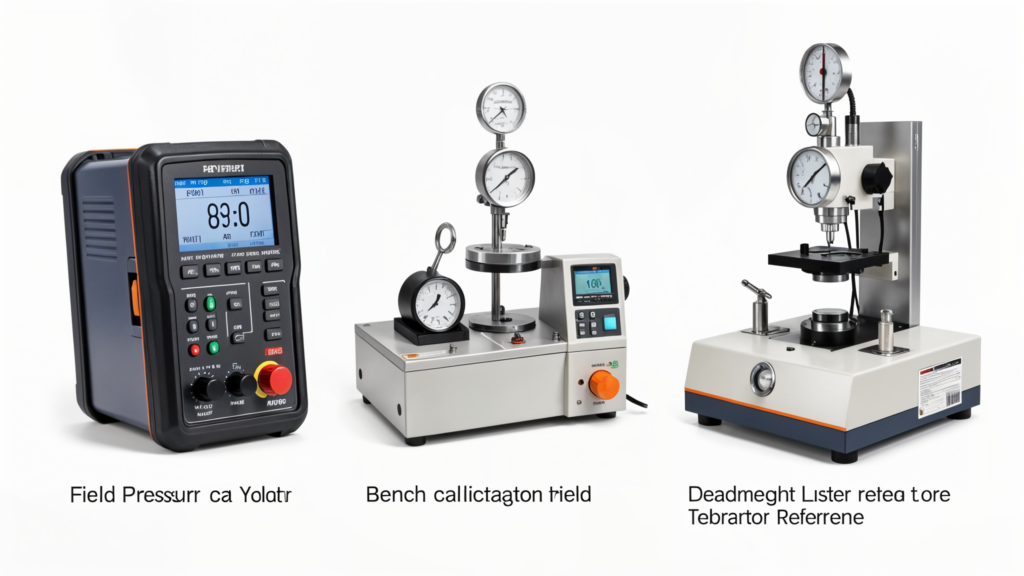
For maintenance teams comparing field, bench, and laboratory equipment, how to choose a pressure calibrator depends on accuracy, range, portability, media compatibility, and documentation requirements. How to choose a pressure calibrator should always begin with the actual calibration procedure.
How to choose a pressure calibrator depends on where the work happens, the required accuracy, the pressure range, and whether you need field portability, bench stability, or laboratory traceability. This guide compares field, bench, and lab pressure calibrators so you can select the right class for your application.
How to Choose a Pressure Calibrator: Start With the Job
When deciding how to choose a pressure calibrator, answer three questions: where will the calibration happen, how often, and what accuracy is actually required? A technician verifying transmitters on a platform needs a rugged, battery-powered, portable unit. A workshop repairing instruments needs a bench unit with more functions and a stable output. A calibration laboratory certifying references needs a primary standard. Most organizations need more than one class, and the decision starts by separating the jobs.
It also helps to know what you are calibrating. Pressure transmitters, pressure switches, pressure gauges, and pressure safety valves all have different accuracy requirements and different procedures. A switch, for example, is verified by its set and reset points, while a transmitter is checked across its full range. The instrument you choose must support the procedures you actually run.
How to Choose a Pressure Calibrator for Field Work
Field (portable) calibrators are built for the plant: battery powered, rugged, compact, and often equipped with an integral pressure pump so the technician can generate pressure on site. They are the workhorse of loop verification — checking transmitters, switches, and gauges where they are installed.
Modern digital field calibrators commonly achieve 0.05% FS accuracy or better, which is more than adequate for verifying most process transmitters in the field. Many include HART communication, letting the technician read the digital process variable and configure the transmitter without interrupting the 4-20 mA loop.
- Choose a field calibrator when: you verify transmitters and switches in the plant, need battery operation, need to generate pressure on site, or work across multiple locations.
- Consider: hazardous-area ratings for classified zones, pump range and media compatibility, and HART capability.
See our pressure calibrators range for portable field options.
Bench Pressure Calibrators: Workshop Workhorses
When learning how to choose a pressure calibrator for workshop work, remember that bench calibrators trade a little portability for capability. They live in the workshop or calibration room, where they calibrate instruments removed from service, support repairs, and provide a stable, repeatable reference for routine work. Bench units typically offer more measurement and source functions than field units — electrical, temperature, and frequency alongside pressure — plus larger displays and easier connection to external pressure sources.
Because a bench calibrator sits in one place, it can be connected to a regulated air or nitrogen supply, giving finer pressure control than a hand pump. That makes it a good fit for calibration work that demands repeatability: checking a batch of transmitters before they are reinstalled, verifying repaired instruments, or supporting instrument shop quality control.
Choose a bench calibrator when instruments come to the workshop for calibration and repair, when you need to cover multiple signal types, or when you want a stable workstation reference. Our calibration instruments and pressure calibrators categories cover bench-style options.
Lab and Primary References: The Deadweight Tester
For teams deciding how to choose a pressure calibrator for laboratory work, the deadweight tester sits at the top of the accuracy chain. Instead of an electronic sensor, it balances a known mass against a piston loaded with pressure. Because the reference depends on mass and local gravity — physical constants rather than electronics — a deadweight tester is treated as a primary reference. It is the instrument you use to calibrate other pressure instruments, including the electronic calibrators used in the field.
- Choose a deadweight tester when: you run a calibration laboratory, you need to certify instruments at the highest accuracy, or you calibrate other pressure calibrators and precision transmitters.
- Consider: pneumatic versus hydraulic models, range coverage, and mass sets.
Deadweight testers are heavier, slower to set up, and more expensive than electronic calibrators, and that is exactly the point: they trade speed for certainty. They anchor the traceability chain that makes every field calibration defensible.
See our deadweight testers category for laboratory references.
Field, Bench, or Lab: A Quick Comparison
- Field calibrator: portable, battery powered, built-in pressure source, best for on-site verification. Accuracy in the 0.05% FS class or better is typical for modern digital units.
- Bench calibrator: workshop based, more functions and better stability, best for repair and routine shop calibration.
- Deadweight tester: primary reference, gravity-based, best for laboratory certification and calibrating other instruments.
Many organizations use all three: deadweight tester in the lab, bench calibrator in the workshop, and portable units with the field teams. The mix is driven by where the work happens and how much accuracy each job really needs.
Key Selection Criteria
Accuracy and Test Uncertainty
Match the reference accuracy to the device under test. A common rule of thumb is that the reference should be several times more accurate than the device being calibrated, so the reference’s error is a small part of the total test uncertainty. Modern digital calibrators at 0.05% FS or better handle most field and workshop work; laboratory certification typically moves up the chain to primary references. Read the full accuracy specification — including temperature effects and stability — not just the headline figure.
Pressure Range and Media
Match the calibrator range to your process pressures, and confirm the media: pneumatic (air or nitrogen) for lower pressures, hydraulic (oil or water) for high pressures. Media compatibility matters, because some hydraulic fluids are not suitable for instruments that later see other media.
Pressure Source
Some calibrators include an integral hand pump; others connect to an external pressure source. If you calibrate in the field, an integral pump is usually worth the convenience. On a bench with a regulated air supply, external sources give finer control.
HART and Communication
If your transmitter population is HART-based, a calibrator with HART communication lets one instrument handle the whole loop: read the digital process variable, trim the transmitter, and verify the analog output.
Documentation and Data Logging
Documenting calibrators record results automatically and transfer them to calibration management software. If your quality system requires records for every calibration, documentation capability saves hours of handwriting and eliminates transcription errors.
Environment and Hazardous Areas
For classified areas, check whether the calibrator carries an appropriate intrinsic safety rating for the zone where it will be used, and select field units accordingly.
Budget and Future Needs
Buy for the work you will do over the next few years, not just this quarter. A documenting calibrator costs more than a simple unit but can replace a stack of paper records; a HART-capable unit protects you when transmitters are upgraded. Consider the total cost: accessories, recalibration, software, and training.
How to Choose a Pressure Calibrator: Official Resources
Before selecting a model, compare the manufacturer specifications with your procedure, required uncertainty, pressure media, and operating environment:
- Fluke pressure calibrator range covers portable pressure calibration equipment and measurement ranges.
- Additel pressure calibrators provides manufacturer information for portable and automated pressure calibration options.
- Fluke pressure calibration resource hub offers additional guidance on pressure measurement and calibration systems.
Always verify the exact model datasheet, certificate requirements, media compatibility, and safety rating before purchase.
Matching the Class to the Job
- On-site transmitter and switch verification → portable field calibrator.
- Workshop repair and calibration → bench calibrator.
- Laboratory certification and primary reference → deadweight tester.
- Quick loop checks and accurate indication → digital pressure gauge.
- Mechanical indication and gauge verification → analog pressure gauge.
Practical Tips Before You Buy
- Write down the accuracy you actually need before comparing prices; over-specifying accuracy is the most common budget mistake.
- Confirm that the calibration certificate is included and traceable.
- Plan the recalibration interval and budget for it.
- Ask about accessories — hoses, fittings, adapters, and carrying cases often cost more than expected.
- Check the operating temperature range against your environment, especially for outdoor and tropical sites.
Not sure which class fits your work? Tell us what you calibrate, where, and at what accuracy, and we will help you match the instrument to the job. Request a quotation for the pressure calibrators that fit your application.
Editorial note: This guide was prepared by the Indo Multimeter Editorial Team for engineers and technicians researching test, measurement, and calibration equipment. Specifications and application guidance should be checked against the manufacturer documentation and the requirements of your calibration procedure.