
Test & Measurement Blog · 24 Sep 2026
Sound Level Meter Calibration: Field Checks, Calibrators and Intervals
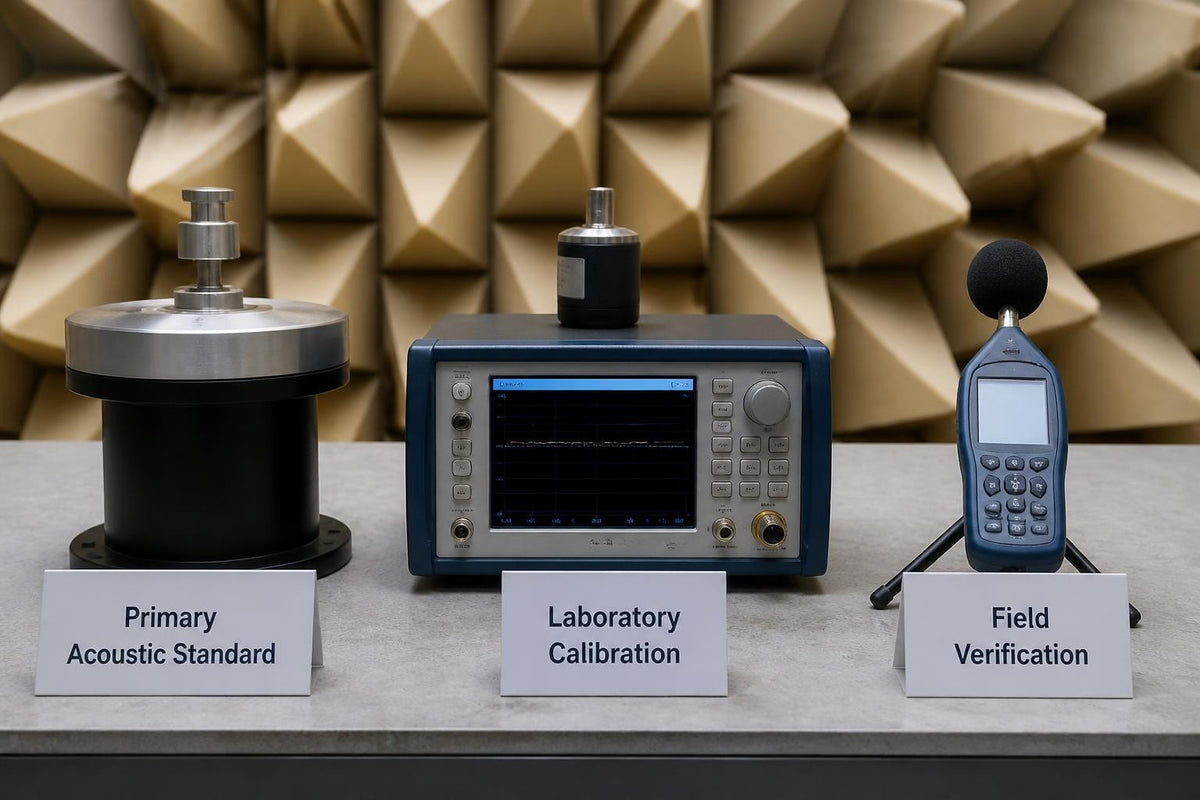
To calibrate a sound level meter in the field, fit a sound calibrator of the same class to the microphone, switch it on and compare the meter reading with the calibrator level, usually 94 dB or 114 dB at 1 kHz. Set the meter to the corrected calibrator level, log the value, and repeat the check after the measurement session. A laboratory calibration to IEC 61672-3 is a separate, periodic test that a calibrator check cannot replace.
This guide covers calibrator classes, a worked field check, what a laboratory test includes and how often to do each. If you need hardware, see our light and sound measurement range.
What is the difference between a field check and a laboratory calibration?
| Item | Field check | Laboratory calibration |
|---|---|---|
| Who and when | The user, before and after every measurement session | A calibration laboratory, at a periodic interval |
| Equipment | Acoustic calibrator (IEC 60942) | Reference calibrator plus electrical and acoustic test equipment |
| What it shows | Sensitivity at one level and one frequency has not changed | Performance against IEC 61672-1 acceptance limits for a set of key tests |
| Result | A log entry and, if needed, an adjustment | A certificate with measured deviations and uncertainty |
A calibrator check proves sensitivity at a single point only. Frequency weightings, linearity and time weightings can drift without showing up in the check, which is why the laboratory test exists.
Which sound calibrator do you need?
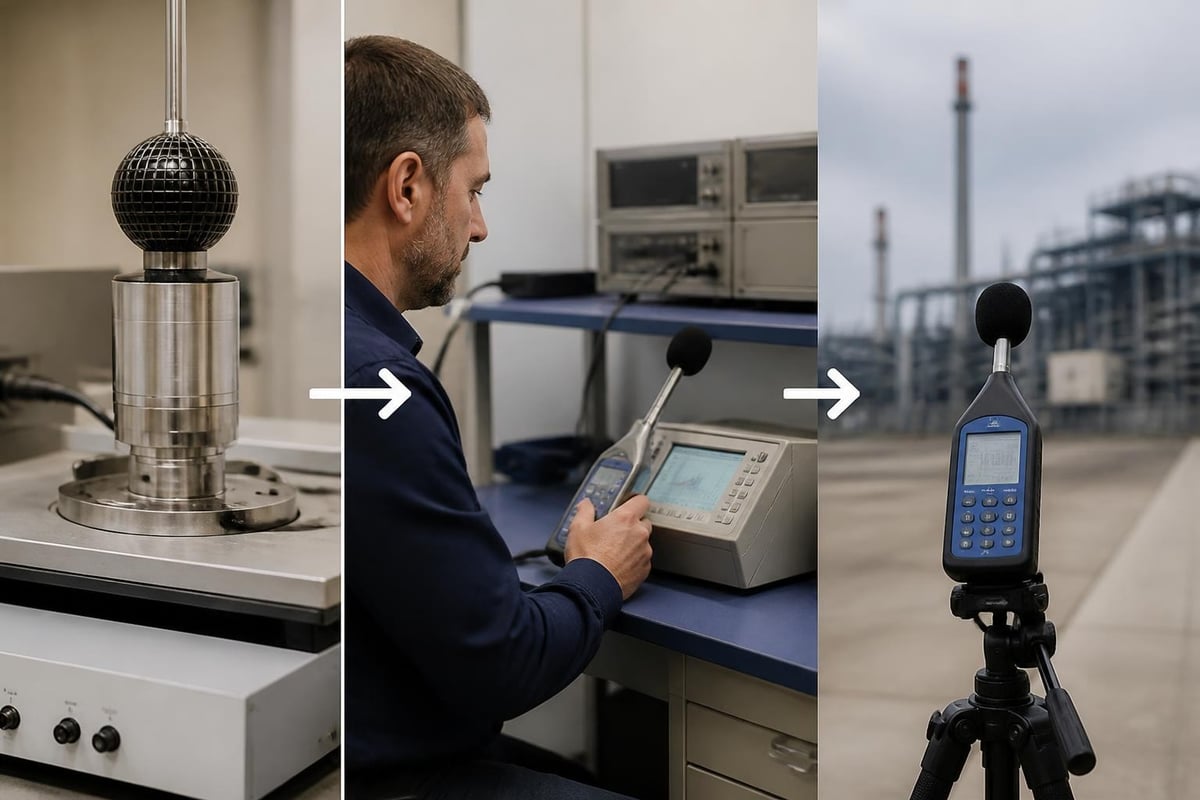
IEC 60942:2017 specifies three calibrator classes: LS (laboratory standard), class 1 and class 2. Acceptance limits are smallest for LS and greatest for class 2, and each class is matched to a sound level meter class in IEC 61672-1. A practical rule from the UK Institute of Acoustics is that a class 1 meter needs a class 1 calibrator. Use the model named in the meter manual, or an equivalent with the same nominal level and frequency (Institute of Acoustics Bulletin, May/June 2022).
- Level. 94 dB is a sound pressure of 1 Pa and 114 dB is 10 Pa, both at 1 kHz. Use the level your meter manual specifies for its reference range.
- Tolerance. The same Institute of Acoustics article puts the calibrator tolerance at 1 kHz between ±0.25 dB and ±0.4 dB depending on the edition of the standard. Use the actual level on the calibrator’s own certificate, not the nominal value.
- Calibrator calibration. A calibrator is only a reference if it is calibrated. For a laboratory meter test, the same article expects the associated calibrator to have been independently calibrated within the previous 12 months.
- Coupler. Check that the calibrator fits your microphone size, or that the correct adaptor is fitted.
Older meters may be specified to older standards. The listing for the Simpson Electric 40006 sound level meter kit gives ANSI S1.4-1983 Type S2A and IEC 651 for the 884-2 meter, and its 890-2 calibrator produces 94 dB or 114 dB at 1 kHz. If a regulation or contract names IEC 61672, check the datasheet before you buy.
How do you do a field check?
- Inspect the microphone grid and cable, remove the windscreen and confirm the battery level.
- Switch the meter on and let it settle. Select the range, frequency weighting and time weighting that the manual names for calibration.
- Fit the calibrator fully onto the microphone, switch it on and wait for the reading to stabilise.
- Work out the level the meter should show: the calibrator certificate level plus any pressure correction from the calibrator manual and any coupling correction from the meter calibration report.
- If the reading differs from that level by more than your acceptance limit, adjust the meter sensitivity and note the before and after values.
- Log date, time, meter and calibrator serial numbers, the level and any adjustment.
- After the session, repeat the check without adjusting and log the reading.
Worked example. A calibrator certificate states 94.05 dB. The calibrator manual gives a pressure correction of −0.03 dB for today’s barometric pressure, and the meter report gives a coupling correction of −0.15 dB. The expected level is 94.05 − 0.03 − 0.15 = 93.87 dB, so the meter should show 93.9 dB. If the post-session check reads 93.6 dB, the drift is −0.3 dB and the data stands against a 0.5 dB limit. A reading of 93.3 dB is −0.6 dB, so the session fails. These numbers are illustrative. Use the corrections from your own documents.
Calibrators that do not compensate for atmospheric pressure need the correction most. The Institute of Acoustics article notes that barometric pressure is usually the largest environmental correction, and that a larger load volume on a non-compensating calibrator lowers its output.
When do you have to discard the data?
It depends on the rule that governs your work. As one published example, Singapore’s Ministry of Manpower asks for a calibration check before and after each noise monitoring session, and if the two readings differ by more than 0.5 dB the readings must be discarded and the monitoring repeated (MOM FAQ). Other regulators and standards set their own limits, so write the limit into your SOP and apply it the same way every time.
What does a laboratory calibration to IEC 61672-3 cover?
IEC 61672-3:2013 gives test procedures for class 1 and class 2 meters that conform to the second edition of IEC 61672-1. It applies whether or not the meter model was pattern approved. Its purpose is to assure the user that the meter still meets IEC 61672-1 for a limited set of key tests. Conformance needs the measured deviations to stay within the acceptance limits and the measurement uncertainty to stay within the maximum permitted value, both at 95 % coverage (IEC abstract).
The tests include, among others:
- indication at the calibration check frequency and self-generated noise;
- frequency weightings, tested acoustically and electrically;
- level linearity across the reference level range and when the range is changed;
- time weighting and toneburst response;
- C-weighted peak level, overload indication and long-term stability.
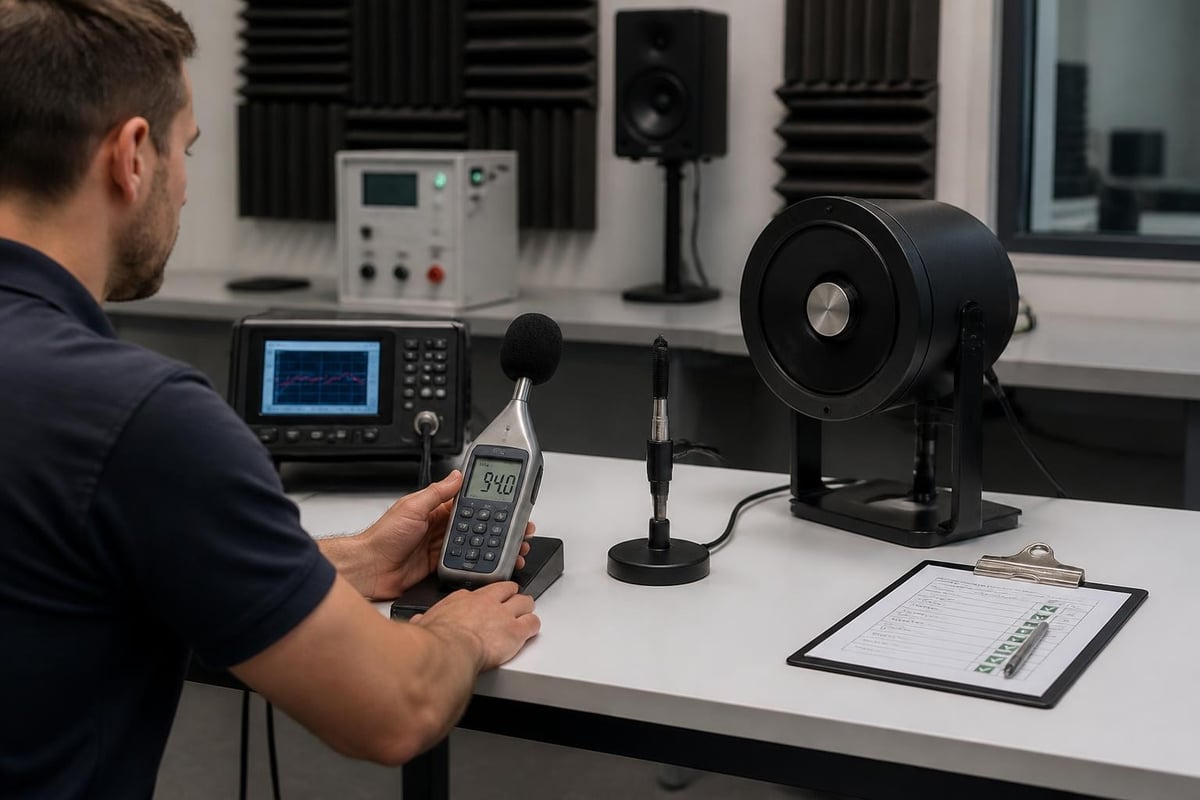
The laboratory normally uses your calibrator and records the level to set during field checks. The Institute of Acoustics notes that the standards allow calibration offsets to centre the response inside the tolerance band, and that the user must know whether any offset was applied. Ask for the full report, not only the pass statement.
How often should a sound level meter be calibrated?
There is no single interval. Regulators, accreditation bodies and makers set it. Singapore’s Ministry of Manpower, for example, requires laboratory calibration every 12 months or as the manufacturer recommends, whichever is shorter. Field checks happen every session. Shorten the interval after a drop, exposure to water or dust, or any failed field check.
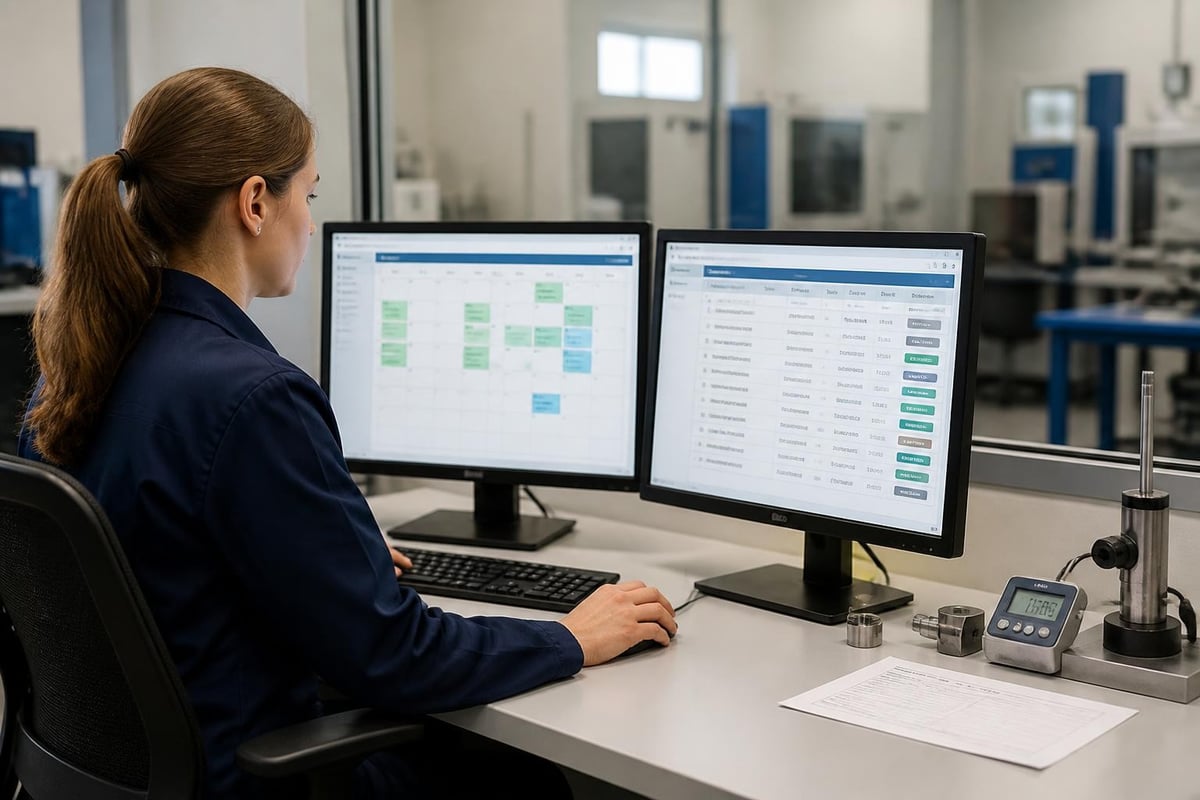
Trend the certificates. In a six-year history published by the Institute of Acoustics, the 1 kHz check level of one microphone fell by 0.2 dB, a drift that only the laboratory data revealed. Treat a calibrator the same way: calibrate it on schedule and keep its certificates with the meter.
Why does a meter fail its calibrator check?
- The calibrator is not fully seated, or the wrong adaptor is fitted.
- The wrong level, weighting or range is selected on the meter or calibrator.
- The pressure correction was missed on a non-compensating calibrator.
- The microphone grid is dirty or wet, or the diaphragm is damaged.
- The calibrator battery is low, or the calibrator is out of calibration.
Reseat and repeat first, then try a second calibrator. If the reading still disagrees, clean the grid as the maker advises, and send the meter for service rather than adjusting it far from the expected level. Moving equipment between an air-conditioned room and a hot, humid site can cause condensation, so let it acclimatise and keep the microphone within the maker’s stated humidity and temperature limits.
Can you log a meter’s output for analysis?
Many meters have analogue outputs. A multi-channel recorder such as the Keysight DAQ973MB, listed with up to 1 MS/s sampling and 24-bit resolution, can record a voltage output as a time history. The recorder is not a sound level meter, and the whole chain needs its own traceable check.
Which instruments can we supply?
- Simpson 40006 kit: sound level meter with its 890-2 calibrator, 40 to 140 dB.
- Extech 407790A: Type 2 octave band analyzer, ±1.5 dB basic accuracy, microSD logging and AC/DC analogue outputs, as listed.
- Simpson 897 dosimeter: 50 to 130 dB, 31 hours of logging.
Confirm the standard and class on each datasheet. See the full range of test instruments at IndoMultiMeter, shipped worldwide.
Frequently asked questions
How often should a sound level meter be calibrated?
Run a calibrator check before and after every measurement session. Laboratory calibration follows the interval set by your regulator, accreditation body or the maker. Singapore’s Ministry of Manpower, for example, asks for 12 months or the manufacturer’s recommendation, whichever is shorter.
What dB level is used to calibrate a sound level meter?
Usually 94 dB or 114 dB at 1 kHz. 94 dB corresponds to a sound pressure of 1 Pa and 114 dB to 10 Pa. Use the level your meter manual specifies.
Can I use a class 2 calibrator on a class 1 meter?
Match the classes. The Institute of Acoustics advises that a class 1 meter needs a class 1 calibrator, because acceptance limits are wider for class 2 and add uncertainty to the check.
What should I do if the before and after readings differ?
Compare the difference with the limit in your SOP or regulation. Singapore’s Ministry of Manpower asks for readings to be discarded and the monitoring repeated if they differ by more than 0.5 dB. Find the cause before the next session.
Does a calibrator check replace laboratory calibration?
No. A calibrator check confirms sensitivity at one level and frequency. IEC 61672-3 laboratory tests cover a wider set of key performance checks, such as frequency weightings and level linearity.