
Test & Measurement Blog · 29 Aug 2026
Mechanical vs Digital Pressure Gauge: When to Use Each
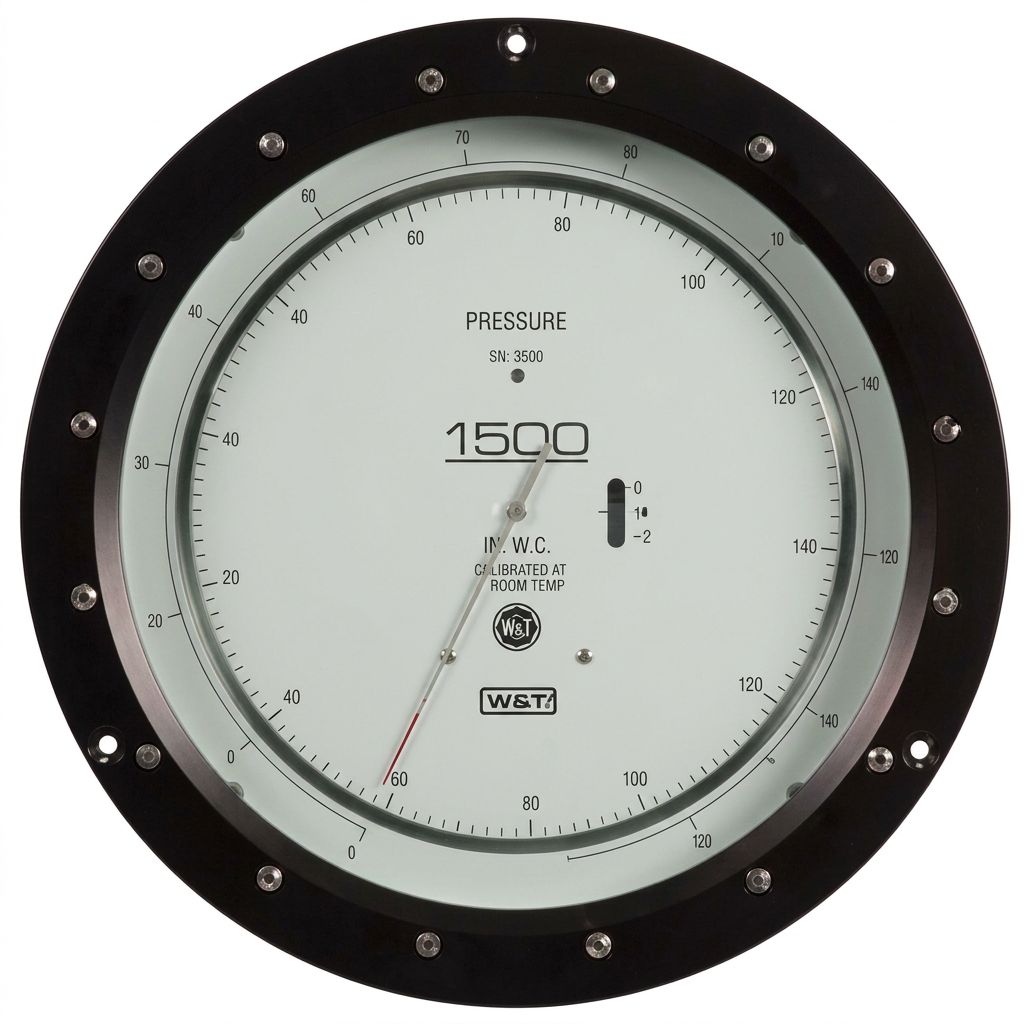
In the mechanical vs digital pressure gauge decision, use a mechanical (Bourdon tube) gauge for local indication where no power is available and an error of 1% to 3% of span is acceptable. Use a digital gauge when you need better than about 0.5% of span, logging, unit switching or an electrical output, as in calibration and commissioning work. Mechanical gauges can be accurate too. An ASME B40.100 Grade 3A test gauge is ±0.25% of span, but it costs more and is harder to read to that level than a digital display.
What is the difference between a mechanical and a digital pressure gauge?
| Feature | Mechanical (Bourdon tube) | Digital |
|---|---|---|
| Sensing element | Bourdon tube, diaphragm or bellows, moving a pointer | Pressure sensor, commonly piezoresistive, with electronics |
| Power | None | Battery or loop power |
| Typical accuracy | 0.25% to 3% of span, depending on grade | 0.05% to 0.5% of full scale, depending on model |
| Readout | Pointer on a dial, one unit, parallax error | Numeric display, selectable units, higher resolution near zero |
| Extra functions | None | Min/max or peak hold, tare, logging, 4-20 mA or USB output on some models |
| Main failure modes | Wear, sticking pointer, pulsation damage | Flat battery, sensor drift, temperature effects |
| Best use | Local indication in process service | Calibration, testing and data capture |
How accurate is each type in practice?
ASME B40.100 defines accuracy grades as maximum error in percent of span. Manufacturer datasheets list Grade 3A at ±0.25%, Grade 2A at ±0.5% and Grade 1A at ±1%. Grades A and B vary across the scale: ±2/1/2% and ±3/2/3% over the lower, middle and upper parts. The Ashcroft explainer on ASME grades shows how to read them. The table works out the allowed error on a 0 to 10 bar range.
| Gauge | Specification | Allowed error on 0 to 10 bar |
|---|---|---|
| Mechanical, Grade B | ±3/2/3% of span | ±0.3 bar at the ends, ±0.2 bar mid-scale |
| Mechanical, Grade A | ±2/1/2% of span | ±0.2 bar at the ends, ±0.1 bar mid-scale |
| Mechanical, Grade 1A | ±1% of span | ±0.1 bar |
| Mechanical, Grade 3A (test gauge) | ±0.25% of span | ±0.025 bar |
| Digital, 0.5% of full scale | ±0.5% FS | ±0.05 bar |
| Digital, 0.05% of full scale | ±0.05% FS | ±0.005 bar |
Read the accuracy statement carefully. Some precision digital instruments state accuracy as a percentage of reading plus a span term, and temperature effects can add error. A gauge rated 0.1% at 23 °C may be worse at 50 °C. Match the spec to the temperature where the gauge will work.
When should you use a mechanical pressure gauge?
- Process displays that an operator reads by eye on pumps, compressors, filters and tanks.
- Locations without reliable power. A mechanical gauge keeps reading in a blackout.
- Rough, vibrating service, using a liquid-filled case to damp pulsation.
- Budget installations where the accuracy grade is not critical.
Limits: lower accuracy in common grades, wear in the movement, sensitivity to pulsation and no data output. A mechanical gauge also needs recalibration after rough service.
When should you use a digital pressure gauge?
- Calibration and verification, where the gauge is the reference for other instruments.
- Commissioning and testing that need accurate, logged readings.
- Low-pressure and vacuum ranges, where a needle lacks resolution.
- Leak and pressure decay tests, where small changes matter.
- Remote monitoring with a 4-20 mA output into a control system.
Limits: it needs power, accuracy can shift outside the rated temperature range, and the purchase cost is higher. Check the enclosure rating for outdoor use.
Which is better for calibration work?
A digital gauge or a digital pressure calibrator, in most cases. The reference must be several times more accurate than the device under test, commonly 4:1. To check a Grade 1A gauge (±1%) you want a reference no worse than ±0.25%. To check a ±0.25% transmitter you want about ±0.06%. Digital instruments reach those figures. Reading a needle adds parallax and resolution error that a numeric display removes. Our step-by-step guide to pressure gauge calibration shows the test points and records, and how to choose a pressure calibrator covers reference selection. For the reference class above digital gauges, see deadweight tester vs digital pressure calibrator.
What about oil pressure gauges on engines?
The same trade-off applies in a simpler form. A mechanical oil pressure gauge is fed by an oil line, so pressurised oil reaches the gauge itself. An electric or digital gauge reads a sender (sensor) fitted to the engine, so only wiring reaches the gauge and no oil line runs to the cabin. Electrical gauges therefore avoid a leaking line near the operator, while mechanical gauges need no power. Choose by installation: for temporary diagnosis a mechanical test gauge is common, and for permanent monitoring a sender and gauge, or a digital readout, is usual.
How do maintenance and recalibration differ?
A mechanical gauge is adjusted mechanically. A technician re-zeroes the pointer, adjusts the linkage or replaces the element, and the adjustment depends on technician skill. A digital gauge is adjusted electronically against a known pressure source with zero and span functions, and the result is recorded on a certificate. For programmes that need traceable records, the digital gauge fits the workflow. For a panel gauge, a mechanical unit is easier to maintain on site. Both types still need a schedule. See how often instruments should be calibrated.
Where can you find both types?
IndoMultiMeter carries analog pressure gauges for process display and digital pressure gauges for accuracy and data. For calibration duties, see the pressure calibrators category. Our guide to the digital pressure gauge covers features in more depth. Not sure which type fits your application? Request a quotation and our team will recommend a gauge for your process conditions and accuracy requirement.
Frequently asked questions
What is the difference between a mechanical and a digital pressure gauge?
A mechanical gauge uses a Bourdon tube, diaphragm or bellows to move a pointer and needs no power. A digital gauge uses a pressure sensor and electronics to show a number, and it can log data, switch units and give an electrical output.
Which is more accurate, a mechanical or a digital pressure gauge?
Digital gauges are usually more accurate, at 0.05% to 0.5% of full scale. Mechanical gauges range from about 3% of span (ASME Grade B) to 0.25% (Grade 3A test gauge), so a good test gauge can match a basic digital gauge.
Do digital pressure gauges need calibration?
Yes. The sensor drifts over time, so a digital gauge needs a calibration schedule like any instrument. Set the interval from drift history, usage and the criticality of the measurement.
Are mechanical pressure gauges safe in hazardous areas?
A passive mechanical gauge has no electronics, which avoids ignition concerns from batteries. Hazardous-area suitability still depends on the specific product and its certification, so check the gauge rating for your zone.
What is the difference between a mechanical and a digital oil pressure gauge?
A mechanical gauge is fed by an oil line, so oil pressure reaches the gauge. A digital or electric gauge reads a sender fitted to the engine, so only wiring runs to the gauge.