
Test & Measurement Blog · 04 Sep 2026
Deadweight Tester vs Digital Pressure Calibrator: Which Do You Need?
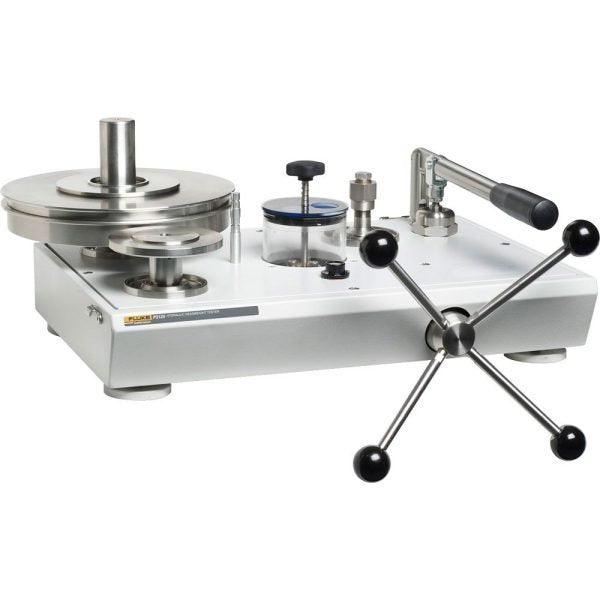
Every pressure calibration program eventually faces the same question: should the reference standard be a deadweight tester or a digital pressure calibrator? There is no single correct answer, because the two instruments solve different problems. A deadweight tester is a primary pressure standard built around mass and gravity; a digital pressure calibrator is a practical, portable electronic tool. Many laboratories and plants end up owning both. This guide explains how each instrument works, where each excels, and how to decide which one you need first.
What is a deadweight tester?
A deadweight tester generates pressure by applying known masses to a precision piston-cylinder assembly. The masses press down on the piston, and the resulting force acting on the known piston area produces a pressure that can be calculated from first principles, with corrections for local gravity, air buoyancy, and temperature. Because the measurement is based on mass and gravity rather than an electronic sensor, deadweight testers achieve very high accuracy, typically in the 0.008% to 0.05% class, and they hold that performance for decades with proper care.
Deadweight testers are available in oil-operated and gas-operated configurations, in bench-mounted and portable forms, and with weight sets that are individually certified and traceable to mass standards. They are the traditional laboratory reference for calibrating pressure gauges, transmitters, and other pressure standards.
What is a digital pressure calibrator?
A digital pressure calibrator combines a precision pressure sensor, a display, and usually a built-in pressure source, such as a hand pump or an electric pump, in a single portable instrument. Many models add electrical measurement and sourcing capabilities for mA and HART signals, which makes them ideal for calibrating pressure transmitters and performing loop checks. Typical accuracy is 0.02% to 0.05% of full scale, which covers the majority of industrial calibration requirements.
Digital calibrators are fast: connect the instrument under test, apply pressure, read the result, and move on. They are battery powered, fit in a carrying case, and can be taken anywhere in the plant. The trade-off is that their sensors are electronic, so they drift with age and must be recalibrated periodically against a higher-level standard.
Accuracy and traceability compared
On paper, the deadweight tester wins on accuracy and stability. A mass-based reference does not drift like an electronic sensor, and its uncertainty can be calculated from the certified masses and local gravity. That is why deadweight testers remain the reference of choice in calibration laboratories and in metrology work where uncertainty budgets are tight.
The digital pressure calibrator is easier to use, but its sensor needs regular recalibration and can be affected by temperature, shock, and overpressure. For typical plant work, the 0.02% to 0.05% of full scale accuracy of a good digital calibrator is more than sufficient. The deciding factor is your uncertainty requirement: if your process demands laboratory-grade accuracy, choose the deadweight tester; if your uncertainty budget allows mainstream digital accuracy, the digital calibrator will save you time and money.
Speed, portability, and ease of use
In the field, the digital pressure calibrator is the clear winner. You switch it on, connect the instrument under test, pump up the pressure, and read the result in seconds. Built-in documentation features record the results for you, and HART-capable models talk directly to smart transmitters.
A deadweight tester is slower and more deliberate. You select the correct masses, load them onto the piston, wait for the piston to float and the system to reach equilibrium, and then read the pressure. That deliberate procedure is exactly why the deadweight tester is trusted as a reference, but it is not practical when you need dozens of quick field calibrations in a single day.
When a digital calibrator is not enough
If your quality system requires very low measurement uncertainty, or if you certify other pressure standards rather than just working gauges and transmitters, the digital calibrator’s sensor is itself the weak link: it must be verified against something better. That something is usually a deadweight tester or another mass-based reference. Similarly, if you need to calibrate over wide ranges with confidence in long-term stability, the deadweight tester’s drift-free nature is hard to replace.
When a deadweight tester is overkill
Conversely, a deadweight tester is overkill for many routine jobs. Calibrating a panel gauge to a few tenths of a percent, checking a pressure switch set point, or verifying a transmitter before a plant turnaround does not need primary-standard accuracy, and the time cost of loading and unloading masses adds up quickly across many instruments. For high-volume work, the speed of a digital calibrator is worth more than the extra accuracy you will not use.
Maintenance and total cost of ownership
Deadweight testers are robust but demanding. The piston-cylinder assembly must be kept clean and free of contamination, the operating fluid must be clean and at the correct level, and the certified mass sets must be handled carefully and sent for periodic recertification. Digital calibrators need less mechanical care, but they require regular electronic recalibration, battery management, and protection from shock and moisture.
Purchase price and ownership cost also differ. A digital pressure calibrator is generally the less expensive route, especially when you factor in recalibration costs. A high-accuracy deadweight tester with a certified weight set represents a larger initial investment, but it can serve as a laboratory reference for decades with very little drift.
Which do you need?
- Laboratory reference with the lowest uncertainty: choose a deadweight tester.
- Field calibrations, transmitter loop checks, and fast turnaround: choose a digital pressure calibrator.
- Calibrating pressure gauges in a workshop to modest tolerances: a digital pressure calibrator is usually enough.
- Verifying and recalibrating your digital calibrators: you need a deadweight tester or another higher-accuracy reference.
- Most plants and calibration laboratories: the practical answer is both, with the deadweight tester as the laboratory reference and digital calibrators for the field.
A practical hybrid approach
Many organizations use a deadweight tester as the laboratory reference and use it to verify digital pressure calibrators on a defined schedule. The digital calibrators then carry that traceability into the field, where they do the daily work of calibrating gauges, switches, and transmitters. This arrangement gives you traceability where it matters most and speed where you need it, and it protects the accuracy of both investments.
The typical arrangement looks like this: the deadweight tester sits in the laboratory and verifies each digital calibrator on a schedule that matches your quality system, often every six to twelve months or after any suspected damage. The digital calibrators then cover field and workshop calibrations in between, and they are trusted because they were recently verified against the primary standard.
Documentation and quality systems
Your choice also affects your paperwork. Deadweight tester uncertainties are typically computed from the certified mass values, the piston area, local gravity, and the relevant corrections, which fits naturally into the uncertainty budgets required by quality standards and accreditation schemes. Digital calibrators come with manufacturer accuracy specifications and calibration certificates, which are usually simpler to record but depend on the sensor’s recent history. Whatever you choose, keep the certificates, the procedures, and the records in order, because auditors will ask for them.
Browse deadweight testers and digital pressure calibrators
Indomultimeter.net carries both technologies. Explore the deadweight testers category for mass-based reference standards, or the pressure calibrators category for portable digital instruments, including models with built-in pressure sources and HART capability.
Request a quotation
Not sure whether your application calls for a deadweight tester, a digital pressure calibrator, or both? Describe your workload and accuracy requirements to our team, and we will recommend the right configuration for your budget. Request a quotation and we will respond with options, specifications, and availability.