
Test & Measurement Blog · 08 Oct 2026
How to Choose a Flowmeter: 7 Selection Factors
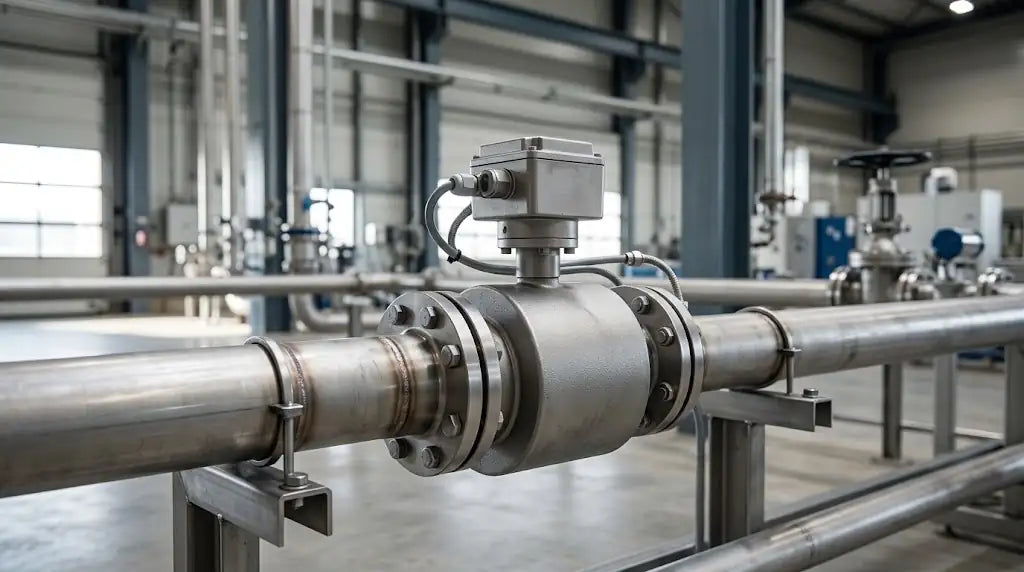
Picking the wrong flowmeter is one of the most common causes of unstable readings, drifting accuracy and early failures in process plants. The right choice comes from the application, not from the catalog. This guide walks through the seven questions that narrow the field quickly, so you can shortlist the right technology before you request a quote.
Quick answer
Start with the fluid (clean liquid, dirty liquid, gas, steam), then the flow range and accuracy you actually need, then the pipe size, pressure and temperature. In most cases these four answers eliminate more than half of the technologies.
1. What is the fluid?
- Clean, low-viscosity liquids (water, solvents): turbine, variable area (rotameter), vortex, electromagnetic (if conductive) and Coriolis all work.
- Conductive liquids and slurries (water-based, wastewater): electromagnetic meters have no moving parts and no pressure drop.
- Non-conductive liquids (hydrocarbons, oils): electromagnetic meters will not work. Consider Coriolis, positive displacement, turbine or ultrasonic.
- Gases and air: thermal mass, vortex, differential pressure and variable area meters are common choices.
- Steam: vortex and differential pressure are the usual options.
2. What flow range do you need to cover?
Check the minimum, normal and maximum flow. Every meter has a usable turndown (the ratio of maximum to minimum measurable flow). A meter sized only for the maximum flow can read poorly at low flow. Choose a meter whose normal operating flow sits in the middle of its range.
3. How accurate does it need to be?
Accuracy costs money. Process monitoring and trending often tolerates a few percent. Batching, blending and billing need much better. Be careful to compare like with like: some manufacturers quote accuracy as a percentage of reading and others as a percentage of full scale, which gives very different results at low flow.
4. Pipe size, pressure and temperature
Confirm line size, connection type, maximum working pressure and fluid temperature. Insertion and clamp-on styles can suit large pipes where an inline body would be expensive. Always check wetted-material compatibility with the fluid.
5. Pressure drop and installation
Differential pressure and turbine meters create pressure drop. Electromagnetic and ultrasonic designs generally do not. Many technologies also need straight pipe runs upstream and downstream to give stable readings, so check the manufacturer’s requirements against the space you have.
6. Output and display
Decide whether you need a local indicator only, or a 4-20 mA, pulse, relay or digital output for a PLC or control system. If the meter feeds a control loop, confirm the signal type before ordering.
7. Total cost and maintenance
Compare purchase price against installation, calibration and maintenance. Meters with moving parts can wear in dirty or abrasive service. Plan periodic checks, and keep calibration records. See our guide to flow meters calibration for how verification is done.
Common flowmeter types at a glance
| Type | Good for | Watch out for |
|---|---|---|
| Variable area (rotameter) | Simple local indication, clean fluids, low cost | Vertical mounting, limited accuracy |
| Turbine | Clean low-viscosity liquids and gases | Moving parts, wear in dirty fluid |
| Electromagnetic | Conductive liquids and slurries, no pressure drop | Does not work on non-conductive fluids |
| Vortex | Liquids, gases and steam | Needs minimum flow to generate vortices |
| Thermal mass | Gas and air flow | Gas composition changes affect readings |
| Differential pressure | Wide range of fluids, long track record | Pressure drop, limited turndown |
| Coriolis | Direct mass flow, high accuracy | Higher cost |
| Ultrasonic | Non-intrusive, clamp-on options | Needs suitable fluid and pipe conditions |
Next step
Browse our range of flowmeters from brands such as Dwyer, or send us your fluid, flow range, line size and output requirements and we will help you shortlist suitable models. For air and gas velocity work, see our air flow measurement instruments. Contact us at info@indomultimeter.net.