
Test & Measurement Blog · 04 Nov 2026
How to Read a Rotameter (Variable Area Flowmeter) Correctly
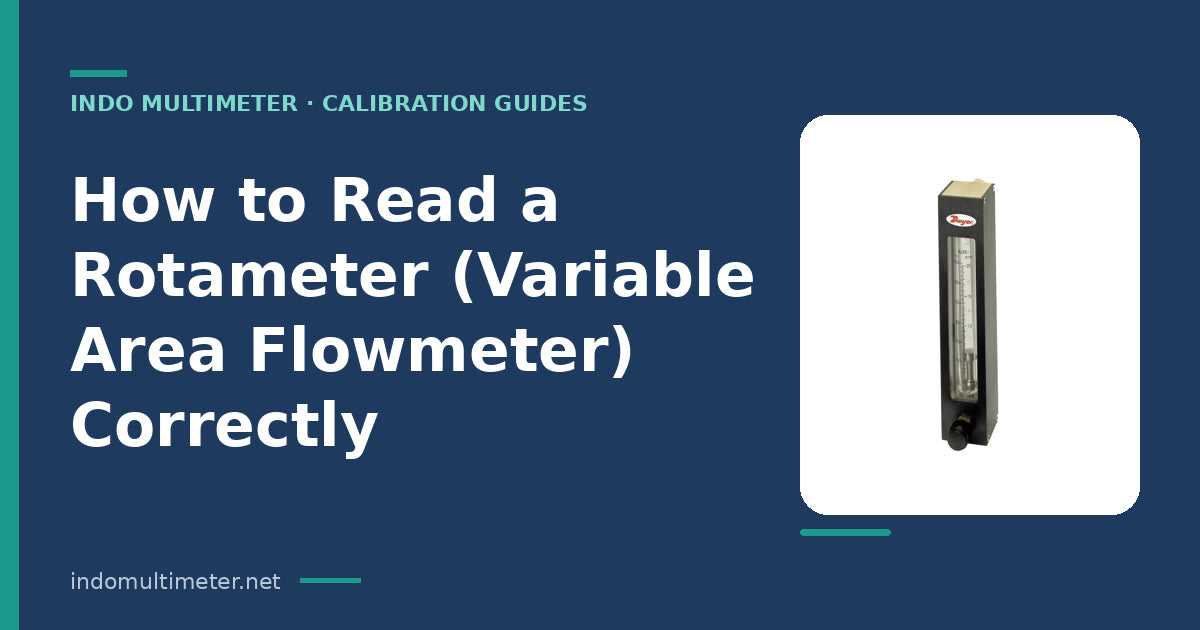
Read a rotameter at the widest part of the float, with your eye level with that point, then convert the scale reading to flow using the correlation chart for that exact part number. Do not assume the scale is in flow units: on many glass meters it is a millimetre scale. If gas type, pressure or temperature differ from the calibration basis, correct the result before you record it.
How a variable area flowmeter shows flow
In a variable area meter, the fluid moves upward through a tapered tube and lifts a float. The float rises until the gap between float and tube wall passes the flow while the float weight is balanced. A higher flow needs a larger gap, so the float sits higher on the scale. The indication is mechanical and direct, so the quality of the reading depends on how you take it as much as on the instrument.
Dwyer describes its Series VA glass flowmeters as having a universal mm scale, supplied with correlation charts that contain calibration data for air and water. The scale is permanently fused ceramic with a vertical locator line, which Dwyer says reduces parallax and eye fatigue. Rotatable-scale designs, such as the Dwyer RSF015V flowmeter, let you turn the scale to the float, but the reading principle is the same.
Reference example: a small glass-tube meter
The table shows the data you need before you take a reading, using the Dwyer VA25429 variable area flowmeter as the example. Values come from the Dwyer Series VA datasheet.
| Item | Dwyer VA25429 / Series VA | Why it matters when reading |
|---|---|---|
| Scale | Universal mm scale, 150 mm (series also offers 65 mm) | The reading is in mm and needs the chart to become flow |
| Maximum flow, air | 0.792 SCFH (374 ml/min) | Defines full scale for the air chart |
| Maximum flow, water | 0.087 GPH (5.5 ml/min) | Defines full scale for the water chart |
| Float | Glass | The chart applies to this float only |
| Accuracy | ±2% FS at 70 °F (21.1 °C) and 14.7 psia | Error is a fraction of full scale, not of reading |
| Repeatability | ±0.25% FS | Useful for trend and setpoint work |
| Turn-down ratio | 10:1 | Below 10% of full scale, accuracy is not specified for useful reading |
| Valve | 6-turn needle valve (standard on valve models) | Allows fine setting while you watch the float |
| Mounting | Vertical | Float rises only when the tube is plumb |
Step-by-step: reading the float
- Confirm the meter is vertical. The datasheet lists vertical mounting. A tilted tube changes how the float sits and rubs against the wall, so check with a level before you trust any reading.
- Find the part number and the matching correlation chart. Dwyer states that the part number should be on the meter or on the correlation data sheet that shipped with it. Do not borrow a chart from a similar model: tube, float and range are specific to the part.
- Set the flow and let the float settle. Change the valve slowly. Wait until the float stops drifting. If it keeps oscillating, the supply is unstable or pulsating, and the average position is the best you can record.
- Bring your eye level with the float. Looking from above or below shifts the float against the scale. Use the vertical locator line on the shield to check that you are square to the tube.
- Read at the widest part of the float. Dwyer’s FAQ states that flow rate is read at the maximum width portion of the float regardless of shape. For a ball float this is its centre. For a tapered or conical float it is the shoulder, not the tip.
- Record the scale value in its own unit. On a universal scale this is millimetres. Write down the scale reading, not only the converted flow, so that someone can re-check the conversion later.
- Convert with the chart. Find the scale reading on the chart for the correct fluid and float. Interpolate between listed points rather than rounding to the nearest line.
- Note the conditions. Record fluid, temperature, inlet and outlet pressure, and the part number next to the result.
Applying corrections when conditions differ
Gas type
A meter calibrated for air reads wrongly on another gas. Dwyer states that a specific gravity correction factor must be considered when monitoring other gases with a meter calibrated for air, and gives the relationship Q2 = Q1 × √(1/S.G.). Use it as a first estimate, and check it against the manufacturer chart for the gas if one exists.
Pressure and temperature
Dwyer states that its standard flowmeters are calibrated for standard atmospheric pressure and temperature in the bore, with standard temperature at 530 R (70 °F). If the meter exhausts to atmosphere, no correction factor is needed. If there is back pressure, Dwyer points to its conversion curves in the full-line catalog or a published equation that uses absolute pressure and absolute temperature. Work in absolute units: gauge pressure and °F will give a wrong factor.
For vacuum service, Dwyer recommends top-mounted valves, which help keep atmospheric pressure in the bore and so preserve accuracy.
Liquids
Series VA charts cover air and water. For other liquids, the water chart cannot be used directly. Density and viscosity change where the float sits, so request a chart or correction for that liquid.
Check the accuracy before you trust a reading
The accuracy on the VA datasheet is a percentage of full scale. That is easy to misread. At full scale on the VA25429 air chart (0.792 SCFH), ±2% FS is about ±0.016 SCFH. At 10% of full scale (0.0792 SCFH), the same ±0.016 SCFH is ±20% of the reading. The meter is in specification, but the number is much less certain than it looks.
Two practical consequences follow:
- Size the meter so normal operation sits in the upper part of the scale, not near the 10:1 limit.
- Quote the accuracy together with the reading when the result goes into a report. For example, state that it is ±2% of full scale, not ±2% of reading.
The accuracy also applies at the datasheet reference conditions of 70 °F (21.1 °C) and 14.7 psia. Outside those conditions, apply the corrections above and expect a larger combined uncertainty. Dwyer’s datasheet also lists a few PTFE models, including VA25425, at ±5% FS, so check the figure for your own part number.
Common reading mistakes
- Reading the top edge of the float. This overreads on most float shapes. Use the widest point.
- Parallax. Reading from an angle moves the apparent float position against the scale. Use the locator line.
- Wrong chart. A chart for another part number, float or fluid gives a clean-looking but wrong number.
- Ignoring back pressure. Throttling downstream of the meter raises the pressure in the tube and changes the actual flow for the same float position.
- Setting the flow too fast. The float overshoots and you read before it settles.
- Dirty or fouled tube. Deposits on the tube or float change the gap and the float position. Clean as the manufacturer allows and recheck.
- Treating mm as flow. A universal scale reading must go through the chart.
When to verify the meter itself
Reading technique cannot fix a drifted or damaged meter. If a float sticks, the tube is scratched or the result disagrees with another instrument on the same line, compare it against a reference flow standard. The procedure and uncertainty considerations are in our guide to flow meters calibration. Dwyer lists optional NIST traceable calibration certificates for Series VA air and water meters (order codes NISTCAL-FL1 and NISTCAL-FL2), which is useful when your quality system needs traceable records.
If you are still choosing between meter types, our article on how to choose a flowmeter compares the selection factors. You can browse available variable area, turbine and ultrasonic units in the flowmeters category.
Quick checklist for each reading
- Meter vertical, part number matches the chart.
- Flow stable, float settled.
- Eye level with the widest part of the float.
- Scale value written down in its own unit.
- Fluid, pressure and temperature noted, corrections applied where needed.
- Accuracy stated as % of full scale.
Manufacturer details used here are in the Dwyer Series VA datasheet and the Dwyer technical FAQ.
Frequently asked questions
Where on the float do you read a rotameter?
Read at the maximum width portion of the float, regardless of its shape, as stated in Dwyer's technical FAQ. Keep your eye level with that point to avoid parallax, and use the locator line on the scale shield where one is fitted.
Is the scale on a glass rotameter in flow units?
Not always. Dwyer Series VA meters use a universal mm scale, and you convert the mm reading to air or water flow with the correlation chart supplied for that part number. Always record the scale reading together with the converted value.
Do I need to correct a rotameter reading for gas type?
Yes, if the meter was calibrated for air and you measure another gas. Dwyer states that a specific gravity correction applies, with Q2 = Q1 x sqrt(1/S.G.). Pressure and temperature corrections are also needed when conditions differ from calibration.
What does ±2% FS accuracy mean for a variable area flowmeter?
It means the error limit is 2% of full-scale flow, not of the reading. At 10% of full scale, the same absolute error is up to 20% of the reading. For the Dwyer VA series, this applies at 70 °F and 14.7 psia.
Where can I find the correlation chart for my meter?
Dwyer states the part number should be on the meter or on the correlation data sheet shipped with it. Use the chart that matches that part number, float and fluid. Charts from similar models can give wrong flow values.
Need help specifying the right instrument?
Send us your application, range and accuracy requirements and our team will respond with a tailored quotation.