
Test & Measurement Blog · 10 Aug 2026
Fluke 1621 KIT Earth Ground Tester: Specs and Buying Guide
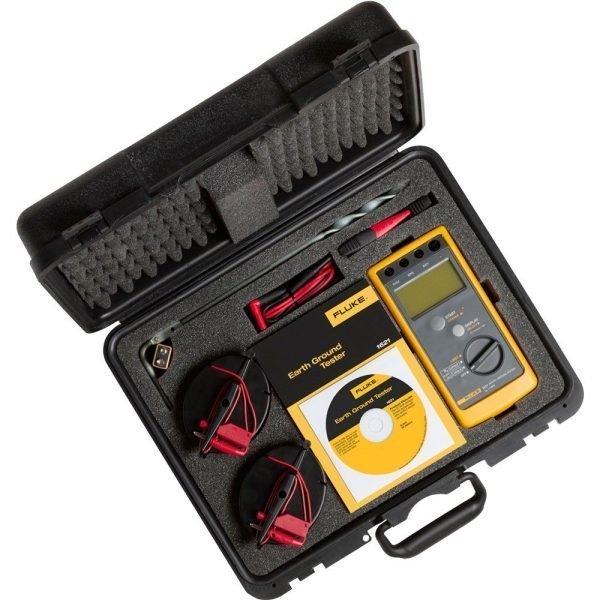
The Fluke 1621 is a handheld earth ground tester for 3-pole fall-of-potential tests from 0.15 ohm to 2 kohm. It also measures 2-pole AC resistance and interference voltage. Fluke lists intrinsic uncertainty of ±(6% of reading + 5 digits) and now marks the 1621 as discontinued, pointing to the 1623-2 GEO. It suits routine electrode checks with two stakes. It does not do stakeless clamp tests or soil resistivity.
What are the Fluke 1621 specifications?
The table lists the figures from the Fluke 1621 KIT product page. Check the current Fluke documentation before you write them into a procedure.
| Parameter | Specification |
|---|---|
| Methods | 3-pole earth resistance (fall of potential), 2-pole AC resistance, interference voltage |
| Measuring method | Current-voltage, per IEC/EN 61557-5 |
| Resistance ranges | 0.15 to 20 ohm (0.01 ohm resolution), 20 to 199.9 ohm (0.1 ohm), 200 to 1999 ohm (1 ohm) |
| Intrinsic uncertainty | ±(6% of reading + 5 digits) |
| Operating uncertainty | ±(18% of reading + 5 digits) |
| Test signal | 128 Hz, 23 to 24 V AC open circuit, more than 50 mA AC short circuit |
| Measuring time | About 8 seconds |
| Interference voltage display | Up to 30 V |
| Safety and protection | 600 V CAT II, IP 40 |
| Power | One 9 V alkaline battery |
| Operating temperature | 0 to 35 °C for specified accuracy; -10 to 50 °C working range |
| Size and weight | 113 x 54 x 216 mm; 850 g with standard accessories |
How accurate is the Fluke 1621?
Fluke gives two figures. Intrinsic uncertainty applies under reference conditions. Operating uncertainty, defined by IEC 61557, includes the influence of the working conditions and is three times larger in the percentage term. The table shows what that means at common readings, where one digit is 0.01 ohm up to 20 ohm and 0.1 ohm on the 200 ohm range (so 5 digits is 0.05 ohm or 0.5 ohm).
| Reading | Intrinsic: 6% + 5 digits | Operating: 18% + 5 digits |
|---|---|---|
| 1.00 ohm | ±0.11 ohm (11%) | ±0.23 ohm (23%) |
| 5.00 ohm | ±0.35 ohm (7%) | ±0.95 ohm (19%) |
| 25.0 ohm | ±2.0 ohm (8%) | ±5.0 ohm (20%) |
Two things follow. For an acceptance limit near 25 ohm, the operating uncertainty can decide a pass or fail, so read the limit against the uncertainty. And the instrument accuracy is rarely the largest error. Fluke notes that high probe resistance causes deviations that fall outside the specified uncertainty, so stake contact and soil moisture matter as much as the tester.
How do you run a fall-of-potential test with it?
- Isolate the electrode. Disconnect the electrode under test from the system so that parallel paths do not distort the reading. Follow the site safety plan.
- Place the current stake. Drive the auxiliary current stake in a straight line from the electrode. The farther it is, the more reliable the test. A common minimum is several times the electrode depth or diagonal.
- Place the potential stake. The widely used 62% rule puts the potential stake at about 62% of the distance from the electrode to the current stake.
- Connect and measure. Wire the tester to the electrode and both stakes, then start the test. Check that the display shows no high-resistance or interference warning.
- Verify the plateau. Move the potential stake about 10% closer and 10% farther and repeat. If the three readings agree, the result is credible. If they differ, move the stakes farther out.
- Record the layout. Note the date, soil condition, stake distances, reading and any corrective action so the next test is comparable.
What resistance should an earth electrode have?
The limit comes from your specification or standard, not from the tester. For example, the US National Electrical Code requires a supplemental electrode when a single rod exceeds 25 ohm. Substations, telecom sites and lightning protection systems often specify much lower values, so use the limit in your project documents. See our overview of the electrical test instruments every technician needs for how ground testing fits with insulation and continuity checks, and the megohmmeter test voltage guide for insulation testing.
Where does the Fluke 1621 fall short?
- No stakeless test. On multi-grounded systems where you cannot disconnect the electrode, a clamp-on ground tester measures the loop without stakes.
- No soil resistivity or selective measurement. It handles 3-pole and 2-pole tests only.
- No data logging. Results are read and recorded by hand.
- The 2-pole method needs a known good ground. The reading includes the resistance of the reference as well as the conductor under test.
- Discontinued. Fluke points to the 1623-2 GEO as the successor.
What can you buy instead of the Fluke 1621?
IndoMultiMeter does not currently list the 1621. For the successor class, see the Fluke 1623-2 GEO earth ground tester, which covers 3-pole and 4-pole soil resistivity, selective and stakeless testing. For stakeless loop resistance and AC leakage, see the Fluke 1630-2 FC earth ground clamp. Browse all ground resistance testers, or send us your site details and acceptance limit and we will suggest a model.
For current specifications and product status, use the official Fluke 1621 KIT page. Manufacturer documentation takes priority over any third-party summary, including this one.
Editorial note: prepared by the IndoMultiMeter Editorial Team from the Fluke specification linked above. It is not the result of bench testing by IMM.
Frequently asked questions
What does the Fluke 1621 measure?
It measures earth ground resistance with the 3-pole fall-of-potential method, 2-pole AC resistance of a conductor, and interference voltage. The resistance range is 0.15 to 2000 ohm.
How accurate is the Fluke 1621?
Fluke lists intrinsic uncertainty of ±(6% of reading + 5 digits) and operating uncertainty of ±(18% of reading + 5 digits). At a 5 ohm reading that is about ±0.35 ohm intrinsic and ±0.95 ohm operating.
Can the Fluke 1621 do stakeless testing?
No. It uses auxiliary stakes for the 3-pole test. Stakeless measurements need a clamp-on earth ground tester or a model with a clamp input.
Is the Fluke 1621 discontinued?
Fluke lists the 1621 KIT as discontinued and suggests the Fluke 1623-2 GEO. Confirm current availability with Fluke or your supplier.
How far should the stakes be placed?
Place the current stake in line with the electrode, as far as site conditions allow, and the potential stake at about 62% of that distance. Repeat with the potential stake moved 10% each way to confirm the reading is stable.