
Test & Measurement Blog · 06 Nov 2026
Crystal nVision Reference Recorder: How to Choose Modules
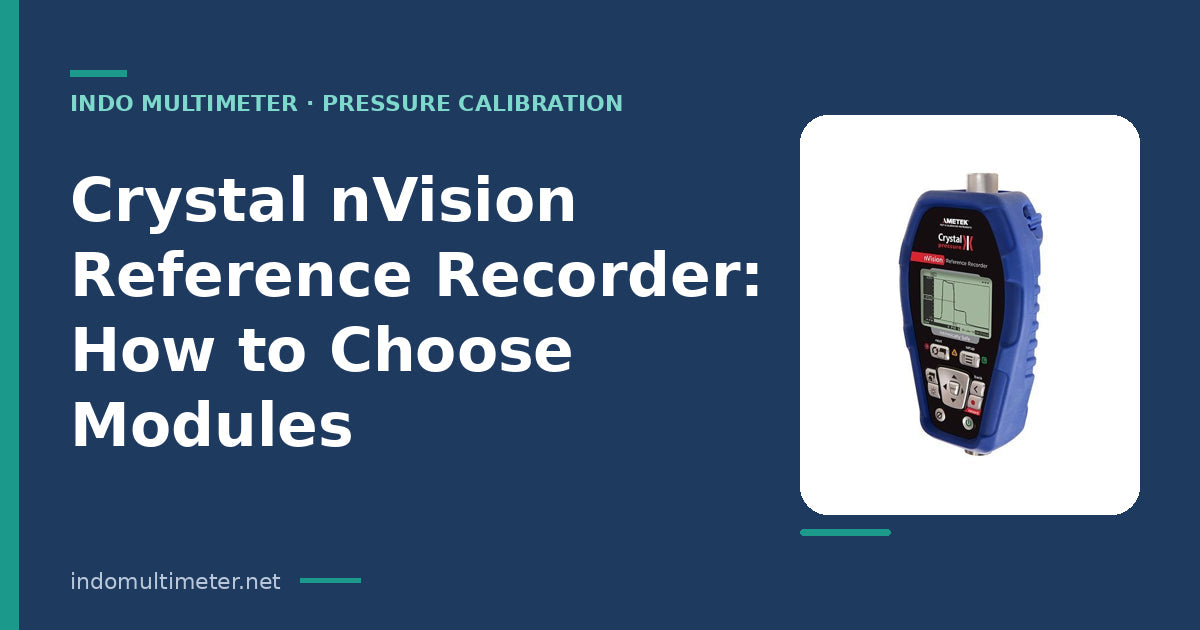
Configure an nVision in three steps. Pick a pressure module whose range keeps your normal test pressures above 30% of full scale. Add an MA20 or RTD100 module only if you also need to read current, voltage, switches or temperature. Add the BARO module if a gauge module must read absolute pressure. Module range sets the accuracy band, so it matters more than any other option.
What an nVision configuration actually decides
The Crystal nVision Reference Recorder, from AMETEK, takes two plug-in modules. The ordering code follows the pattern NV-4AA, then an upper module, a lower module, and an optional BARO suffix. Each slot takes a pressure module (PM), a current/voltage/switch module (MA20), a temperature module (RTD100), or a blank plate. The two slots, plus the BARO option, are the whole configuration decision. The chassis is common to every variant.
The AMETEK nVision product page lists gauge and absolute pressure to 15,000 psi (1000 bar), accuracy up to 0.025% of reading, and recording of two modules at up to 10 readings per second.
Step 1: choose the pressure module range
The bar datasheet gives accuracy in two bands per module. Below 30% of range the specification is a percentage of full scale. From 30% to 110% of range it is a percentage of reading. It includes linearity, hysteresis, repeatability, temperature and one year of stability.
| Module (bar) | Overpressure | 0 to 30% of range | 30 to 110% of range |
|---|---|---|---|
| 3 | 3.0x | ±0.0075% of full scale | ±0.025% of reading |
| 10 | 2.0x | ±0.0075% of full scale | ±0.025% of reading |
| 30 | 2.0x | ±0.0075% of full scale | ±0.025% of reading |
| 100 | 2.0x | ±0.015% of full scale | ±0.05% of reading |
| 300 | 1.5x | ±0.015% of full scale | ±0.05% of reading |
| 700 | 1.5x | ±0.015% of full scale | ±0.05% of reading |
| 1000 | 1.3x | ±0.015% of full scale | ±0.05% of reading |
These figures come from the bar datasheet. Modules sold in psi should be checked against the psi datasheet for the matching range.
A worked example
Suppose you check a 20 bar transmitter. A 100 bar module reads it in the lower band, at ±0.015% of full scale, which is ±0.015 bar. A 30 bar module reads 20 bar in the upper band, at ±0.025% of reading, which is ±0.005 bar. The same recorder gives a three times smaller error contribution, just by changing the module. Meanwhile the overpressure factor tells you how much margin each module has: 2.0x on a 30 bar module, 1.3x on a 1000 bar module.
For vacuum work the datasheet gives ±0.06% of full scale on the 3 and 10 bar modules (full scale taken as -1.0 bar). The 30 bar module adds ±1 LSD. AMETEK notes that the modules are not recommended for continuous use at high vacuum.
Step 2: decide what goes in the second slot
Many users fit two pressure modules of different ranges. A low and a high module covers a wide span of test points, and it keeps each reading in its better accuracy band. The other options add measurement types.
| Slot option | What it measures | Datasheet specification |
|---|---|---|
| PM | Gauge pressure | 3 to 1000 bar, see table above |
| MA20 | Current, voltage, switch state | 0 to 55 mA, ±(0.015% of reading + 0.002 mA); 0 to 28 VDC, ±(0.015% of reading + 0.002 V) |
| RTD100 | Pt100 temperature | 0 to 400 ohm, ±(0.015% of reading + 0.02 ohm), 2-, 3- or 4-wire |
| BNKPLT | None (blank plate) | Used when only one module is fitted |
MA20: loop current and switch tests
The MA20 is intended for 4-20 mA loop work and can show current as a percentage of 4-20 mA or 10-50 mA. It reads supply voltages too. For switch testing it provides an auxiliary fixed output and reports state change and deadband. Closed-state resistance is below 10 ohm and open-state resistance is above 10 megohm. The module includes a 250 ohm HART resistance and test lead kit 3952. If you calibrate pressure switches or transmitters with a hand pump, this module saves carrying a separate multimeter. For loop procedures, see our pressure hold test guide.
RTD100: temperature alongside pressure
The RTD100 reads Pt100 sensors to IEC 60751 curves with 0.01 resolution. It includes the RTD connection kit 3953, but no probe is included. At 0 °C the datasheet gives the recorder’s own contribution as ±0.04 ohm, or ±0.09 °C. A Class A probe adds most of the total, which the datasheet puts at ±0.17 °C for the combination at 0 °C. A Class B probe brings it to ±0.31 °C. The probe class, not the module, sets the temperature uncertainty.
Step 3: add the BARO module for absolute readings
The BARO option lets a gauge module display absolute pressure. Its range is 700.0 to 1100.0 mbarA, with accuracy of ±0.5 mbar (±0.00725 psi). With BARO fitted, the lower end of each module follows its own absolute table. For a 100 bar module the datasheet gives ±0.015 barA from 1 to 31 barA, then ±0.05% of reading to 101 barA. Choose BARO when you record at low pressure or compare against absolute transmitters. Skip it if every instrument you test is a gauge-pressure device.
Differential mode with two pressure modules
Two pressure modules can read differential pressure. AMETEK’s tare function improves uncertainty when both modules have the same full-scale range. It needs an equalizing valve. With tare and a 1 second logging interval, a pair of 30 bar modules is specified at the greater of 0.4 mbar or 0.025% of DP reading. A pair of 100 bar modules is the greater of 1.0 mbar or 0.05%. Without tare, the datasheet advises combining the two module uncertainties by root sum of squares. For example, a 0.025% module with a 0.05% module gives 0.056%.
Power, ratings and pump systems
The chassis operates from -20 to 50 °C and is rated IP66 and IP67. A typical set of 4 AA batteries gives about 200 hours, and the datasheet quotes up to 60 days on the ultra-low-power setting. The unit carries ATEX and IECEx Ex ia IIB T4 Ga or T3 markings, but only when powered by the battery types listed in the datasheet. Check that list before taking a unit into a hazardous area. The product page also warns against using the USB interface in a hazardous atmosphere.
AMETEK sells the recorder with optional pump systems, from pneumatic hand pumps (System A: 0 to 30 psi/2 bar or 0 to 580 psi/40 bar) up to hydraulic bench-top pumps to 15,000 psi/1000 bar (Systems F and G). Match the pump to the higher module in your configuration, not the lower one.
Example configurations in the catalog
The listings below show how the slots are combined. Specifications are the manufacturer’s, not IMM’s own test results.
- NV-4AA-MA20-100PSI-BARO-B: a 100 psi module, an MA20 and BARO. It suits transmitter calibration where you source pressure and read the loop current together.
- NV-4AA-RTD100-30PSI-BARO-B: a 30 psi module, RTD100 and barometric reference. It suits low-pressure work where temperature is logged with pressure.
- NV-4AA-30PSI-1KPSI-B: 30 psi and 1000 psi modules. A wide span with each end kept in a good accuracy band.
- NV-4AA-10KPSI-10KPSI-BARO-B: two 10,000 psi modules and a barometer. Two modules of the same range allow differential use with tare.
All of these sit in the Multifunction Dataloggers category. If you are still deciding between a recorder and a calibrator with a built-in pump, read How to Choose a Pressure Calibrator first.
Procurement checklist
- List your test pressures, then pick the smallest module that covers the maximum with its overpressure margin.
- Check that most test points fall above 30% of the module range.
- State whether you need absolute readings. If so, specify BARO.
- Decide on loop, switch or temperature work. Add MA20 or RTD100 accordingly, and budget a Pt100 probe separately.
- Confirm the hazardous-area requirement and the battery type used.
- Confirm the calibration certificate scope and the datasheet version (bar or psi) with the supplier.
Frequently asked questions
How many modules does an nVision take?
The AMETEK datasheet shows an upper and a lower module slot. Each slot takes a pressure module, an MA20 current/voltage/switch module, an RTD100 temperature module, or a blank plate. A BARO module is a separate option. The recorder logs two modules at up to 10 readings per second.
What is the nVision pressure accuracy?
It depends on the module range and the reading. On the 3, 10 and 30 bar modules the datasheet gives ±0.0075% of full scale up to 30% of range and ±0.025% of reading from 30 to 110%. For 100 to 1000 bar modules the figures are ±0.015% of full scale and ±0.05% of reading.
Do I need the BARO module?
Only if you want a gauge-pressure module to display absolute pressure. The BARO module covers 700.0 to 1100.0 mbarA with ±0.5 mbar accuracy. If every device you test reads gauge pressure, you can leave it out.
Can the nVision measure 4-20 mA signals?
Yes, with the MA20 module. It measures 0 to 55 mA at ±(0.015% of reading + 0.002 mA) and 0 to 28 VDC. It also supports dry-contact switch tests, with closed-state resistance below 10 ohm and open-state resistance above 10 megohm.
Is the nVision intrinsically safe?
The datasheet lists ATEX and IECEx Ex ia IIB T4 Ga or T3 markings, but only when the unit is powered by one of the approved battery types it names. The AMETEK product page also warns against using the USB interface in a hazardous atmosphere.
Need help specifying the right instrument?
Send us your application, range and accuracy requirements and our team will respond with a tailored quotation.