
Test & Measurement Blog · 02 Nov 2026
Handheld vs Benchtop Oscilloscope: Which Should You Buy?
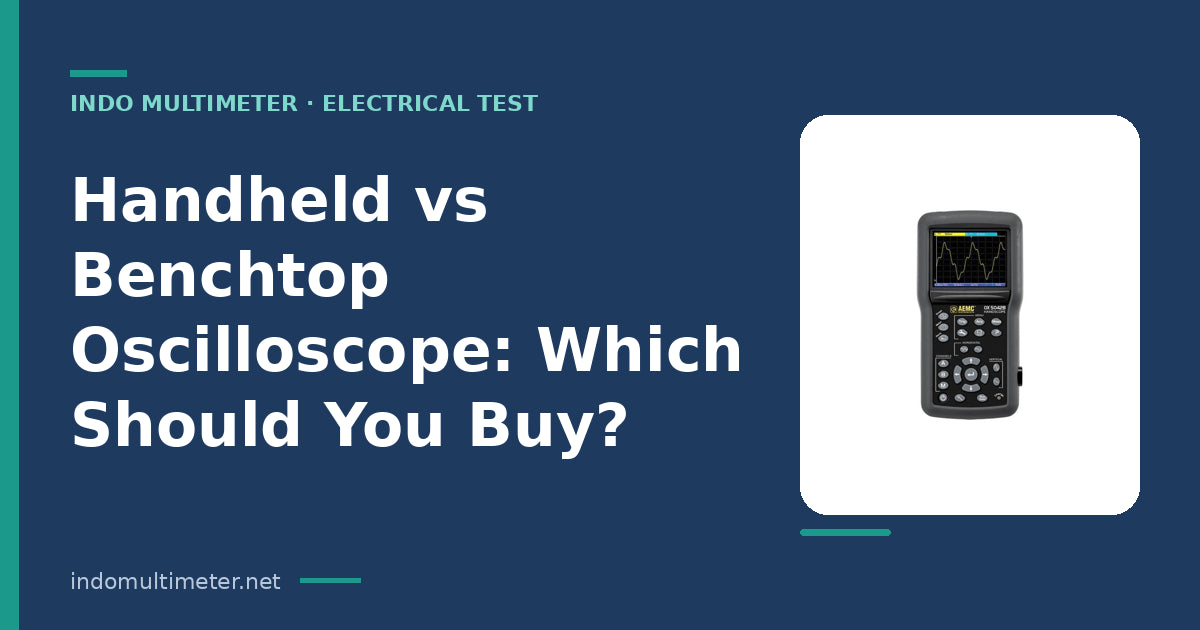
Buy a handheld oscilloscope if you measure in plants, panels and vehicles, especially on floating circuits where isolated channels and battery operation matter. Buy a benchtop oscilloscope if the work is done at a desk and you need deeper memory, higher sample rates and a larger screen. The decision rests on where the measurement happens, not on bandwidth alone.
The Deciding Question: Where Will the Scope Be Used?
Handheld and benchtop scopes both display voltage against time, but they are built for different jobs. A handheld unit is a battery-powered, sealed instrument that you carry to the machine. A benchtop unit is a mains-powered instrument that stays in a lab or repair bay and connects to a known, grounded setup.
Three practical differences follow from that split:
- Input isolation. On most benchtop scopes the ground leads of all channels share one reference point. Clip two ground leads onto two different nodes and you short them together. Handhelds in the AEMC range use individually isolated channels, so each channel can sit on a different potential.
- Acquisition performance. Benchtop models typically offer larger memory, faster sampling and a faster waveform update rate.
- Portability and ruggedness. Handhelds run on batteries, are small enough for a toolbag, and AEMC lists IP54 protection on the models discussed below.
What the Handheld Class Looks Like: AEMC ScopiX IV and Handscope
AEMC lists five handheld models on its official oscilloscope pages. Three cover most buying decisions:
- OX 5042B (Handscope): two isolated channels at 40 MHz, with a 3.5-inch display, an 8,000-count multimeter and harmonic analysis up to the 31st harmonic.
- OX 9104 IV: four isolated channels at 100 MHz, 12-bit resolution and a 7-inch touch screen.
- OX 9304 IV: the same platform with four channels at 300 MHz.
The OX 9062 IV (2 channels, 60 MHz) and OX 9102 IV (2 channels, 100 MHz) fill out the range. All of these also include a built-in multimeter function, which is useful when you move between measuring a level and looking at its waveform.
Handheld vs Benchtop: Specs Side by Side
The table uses the manufacturers’ published figures. The Keysight InfiniiVision models represent entry-level benchtop scopes; they are not the only benchtop choice.
| Model | Type | Channels | Bandwidth | Max sample rate | Vertical resolution | Memory | Display |
|---|---|---|---|---|---|---|---|
| AEMC OX 5042B | Handheld | 2 isolated | 40 MHz | 50 MS/s per channel single-shot; 2 GS/s ETS | 9 bit single-shot (12-bit vertical converter) | 2,500 points per channel | 3.5 in |
| AEMC OX 9104 IV | Handheld | 4 isolated | 100 MHz | 2.5 GS/s per channel one-shot; 100 GS/s ETS | 12 bit | 100 kpts per channel | 7 in |
| AEMC OX 9304 IV | Handheld | 4 isolated | 300 MHz | 2.5 GS/s per channel one-shot; 100 GS/s ETS | 12 bit | 100 kpts per channel | 7 in |
| Keysight DSOX1204A | Benchtop | 4 analog | 70 MHz (upgradeable to 100 or 200 MHz via option) | 2 GSa/s | 8 bit | Up to 2 Mpts | 7 in |
| Keysight DSOX3012A | Benchtop | 2 analog | 100 MHz | 5 GSa/s | 8 bit | Up to 4 Mpts | 8.5 in |
How to Read the Table
Three points matter more than the headline bandwidth.
Memory depth. The benchtop models store 2 to 4 Mpts against 100 kpts on the ScopiX IV and 2,500 points on the OX 5042B. More memory lets you keep a high sample rate over a longer time window, for example when you capture a motor start-up or a switching event and then zoom in on one cycle.
Resolution. The AEMC units quote 12-bit resolution against 8-bit on the Keysight scopes. This helps when you look at small signals on top of a large offset. It does not make a 12-bit handheld a better choice for fast logic or timing work, where sample rate and update rate dominate.
Sample rate versus bandwidth. The OX 9304 IV samples at 2.5 GS/s one-shot for 300 MHz, roughly 8 samples per cycle of the bandwidth limit. The OX 5042B samples at 50 MS/s in single-shot mode for 40 MHz, about 1.25 samples per cycle. Its 2 GS/s figure applies to ETS mode, which reconstructs a repetitive signal from many acquisitions and does not capture a single event. That distinction matters if you plan to chase intermittent faults. See our guide on how much oscilloscope bandwidth you need for the general sizing rules.
When a Handheld Is the Right Tool
Choose a handheld when most of these apply:
- You measure on live power electronics. Drives, inverters, UPS systems and switch-mode supplies often have no grounded node you can safely reference. Isolated channels let you place each ground lead where the circuit requires.
- You compare signals at different potentials. Four isolated channels on the OX 9104 IV can look at, for example, three phases and a control signal at the same time.
- You work away from a bench. AEMC quotes approximately 8 hours of battery life on the OX 9104 IV and OX 9304 IV, and up to 8 hours 30 minutes on the OX 5042B.
- You need one instrument for several jobs. The multimeter function, recording mode and, on the OX 5042B, harmonic analysis reduce what a technician has to carry.
Handhelds suit maintenance, commissioning and fault-finding. Our overview of the meter scope category covers this class in more depth.
When a Benchtop Scope Is the Better Choice
A benchtop scope is the better fit if the following describe your work:
- Embedded and electronics development. Deeper memory and a faster update rate help you find rare glitches in a stream of normal activity. The Keysight DSOX1204A page lists up to 200,000 waveforms per second and the DSOX3012A page lists 1,000,000 waveforms per second.
- Several people share the instrument at a fixed station. A larger screen is easier for teaching, review and incoming inspection. The Keysight DSOX3012A has an 8.5-inch display.
- You need channel count at a low entry point in a bench class. The Keysight DSOX1204A provides four analog channels, and Keysight lists 100 MHz and 200 MHz upgrade options for it.
- The bandwidth you need may change later. Upgradeable bench platforms let you buy for today’s signals. Check which options are available for the model you shortlist.
Safety Ratings: Read Past the Headline
Isolation protects the instrument and the operator only within its rated limits. Before you buy for work on mains or industrial supplies, confirm the rating of the whole measurement chain: the scope input, the probe and the accessories. A scope with a high input rating used with a lower-rated probe is limited by the lower rating.
Read the AEMC specifications carefully. The OX 9104 IV page lists the maximum input as 600 V CAT III, with 1000 V when using Probix connectors, while its safety line cites IEC/EN 61010-2-30 at 1000 V CAT II and 600 V CAT III. The OX 5042B page lists 600 Vrms CAT III maximum input, with derating of 20 dB per decade above 100 kHz. In both cases the rating depends on the accessory and the frequency, so use the manual for the exact combination you will use.
For benchtop scopes, check the input and probe voltage ratings and the measurement category in the datasheet, and do not assume that a bench scope is suited to direct mains measurement.
Procurement Checklist
- Define the circuits. Floating or grounded, mains-connected or low-voltage. This alone often decides the form factor.
- Set the signal bandwidth. Use the fastest edge or highest frequency you must see, then apply a margin as described in the bandwidth guide.
- Check single-shot sample rate. Do not accept an ETS or interleaved figure as the capture rate for one-time events.
- Match memory to capture time. Ask how long you must record at the sample rate you need.
- Confirm probes and ratings. Ask what probes are supplied and what they are rated for.
- Plan for calibration. Confirm whether your quality system needs a calibration certificate with the instrument and what options the manufacturer lists.
Browse the full handheld oscilloscopes category to compare current listings. For the benchtop models above, see the manufacturer pages, such as the Keysight DSOX1204A product page.
Summary
Handheld scopes trade memory depth and screen size for isolated channels, battery operation and a sealed housing. Benchtop scopes trade portability for acquisition performance. If your signals are floating and your work is in the field, start with the AEMC ScopiX IV family. If your work is at a desk and your signals share a ground, a benchtop scope gives more capture capability for the same bandwidth.
Frequently asked questions
Can a benchtop oscilloscope measure floating circuits?
Not safely by default. On most benchtop scopes the channel ground leads share one reference, so connecting them to different nodes creates a short. Isolated channels, as on the AEMC ScopiX IV handhelds, or an isolation method suited to the application, are needed for floating measurements.
Is a 12-bit handheld scope more accurate than an 8-bit benchtop scope?
Not necessarily. Resolution describes the vertical step size of the converter, while accuracy is a separate specification. AEMC lists ±2% vertical accuracy on the OX 9104 IV. For fast timing work, sample rate and bandwidth matter more than bit depth.
What does ETS mean on a handheld scope spec sheet?
ETS is equivalent-time sampling. The scope builds a waveform from many acquisitions of a repetitive signal, which gives a high effective rate. It cannot capture a one-time event. For single-shot events, use the real-time one-shot sample rate, such as 50 MS/s on the OX 5042B.
Which AEMC handheld scope has four channels?
AEMC lists two four-channel models in its ScopiX IV range: the OX 9104 IV at 100 MHz and the OX 9304 IV at 300 MHz. Both have individually isolated channels, a 7-inch touch screen and a four-channel 8,000-count multimeter function.
Need help specifying the right instrument?
Send us your application, range and accuracy requirements and our team will respond with a tailored quotation.