
Test & Measurement Blog · 15 Sep 2026
Gas Detector Calibration Gas: Shelf Life and Test Limits
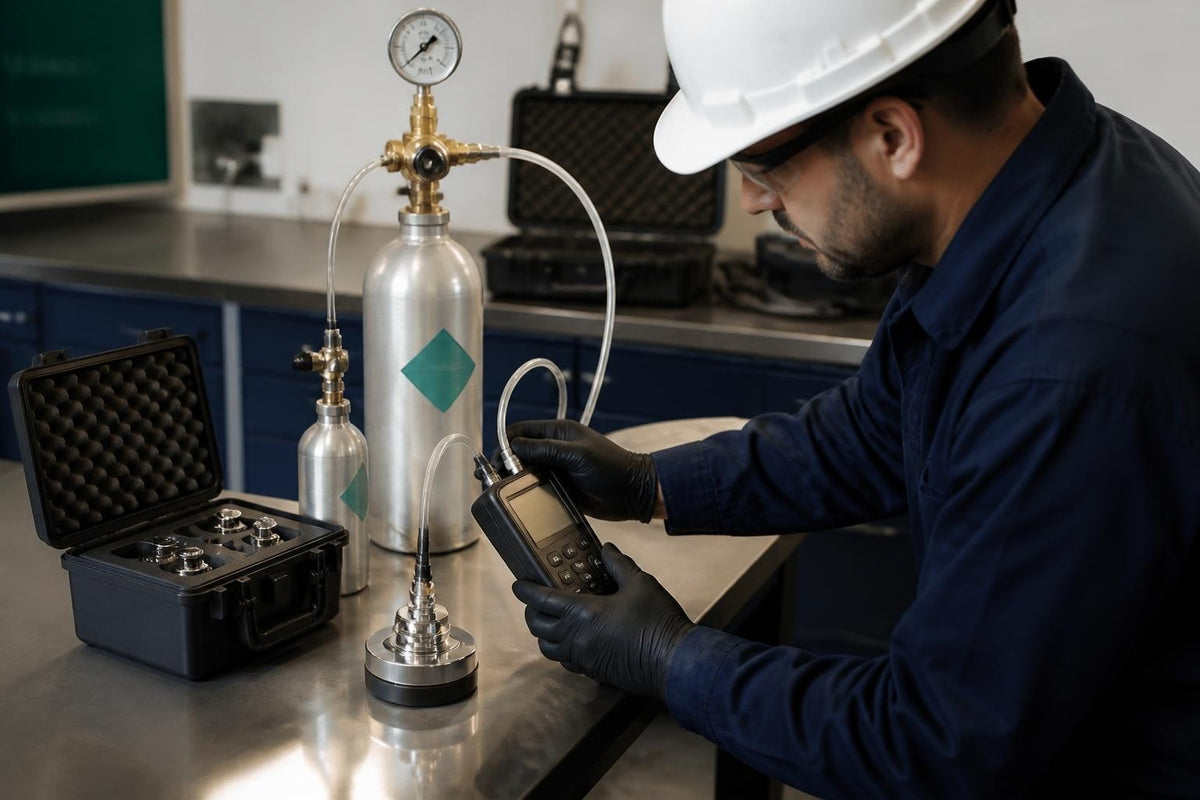
Gas detector calibration gas is a certified mixture of the target gas in a balance gas such as nitrogen or air. Use the gas and concentration your detector manufacturer specifies, from a certified cylinder with a certificate of analysis that has not passed its expiry date. Check the detector with a bump test or calibration check before each day’s use, and do a full calibration whenever it fails or at the interval your procedure sets. Never calibrate with an expired cylinder.
How long does calibration gas last?
Reactive gases react with moisture, oxygen or the cylinder wall, so the concentration drifts over time. Industrial Scientific’s published chart, based on its quality guarantee, gives these shelf lives (source):
| Gas | Shelf life |
|---|---|
| LEL gases (methane, pentane, hydrogen), O2, CO, CO2 | 28 months |
| H2S, SO2 | 19 months |
| NH3, NO, HCN, PH3 | 14 months |
| HCl | 9 months |
| Cl2 | 7 months |
| NO2 | 4 months |
| 4-gas bump cylinder, CO bump cylinder | 9 months |
In a combination cylinder, the expiry date follows the gas that expires first. These figures are one supplier’s guarantee, so use the date printed on your own cylinder. Store cylinders as the supplier directs and use the oldest unexpired stock first.
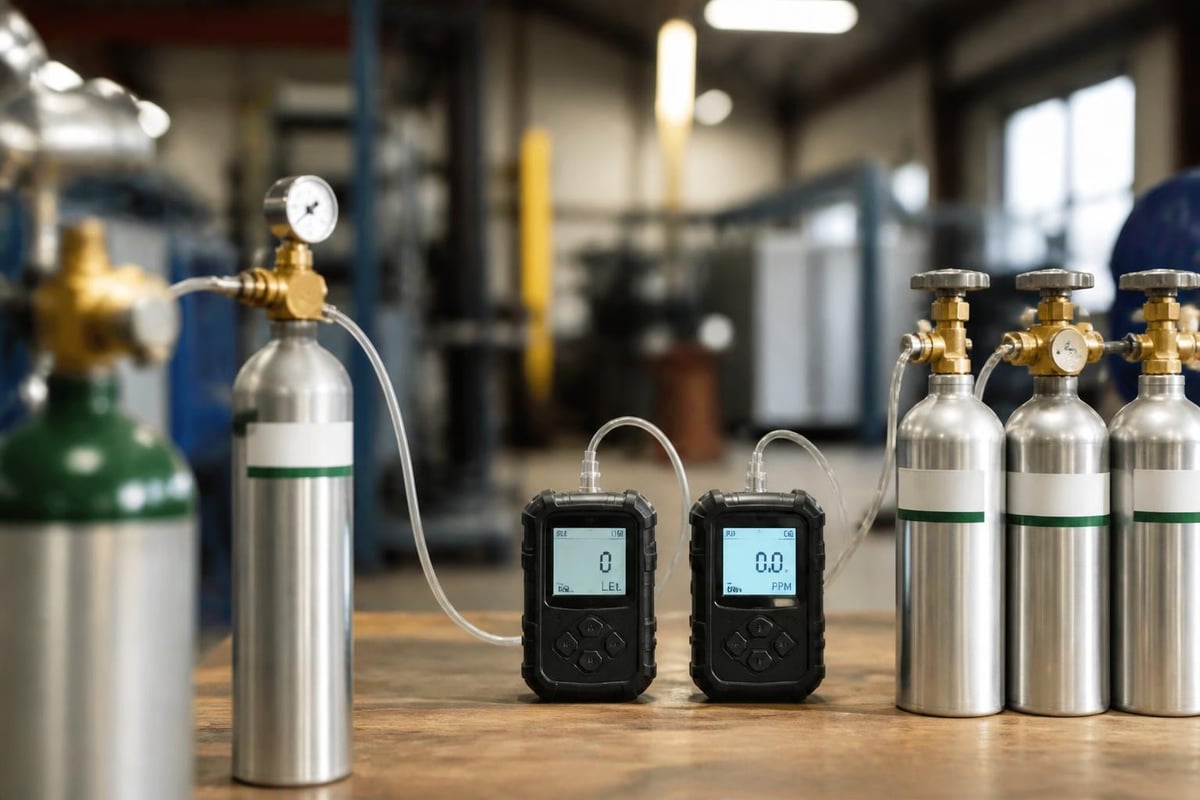
Which gas and concentration do you need?
The detector manual decides. As a general guide:
| Sensor | Typical calibration gas | Notes |
|---|---|---|
| Combustible (catalytic bead, infrared) | Methane, propane, pentane or hydrogen in air | Use the gas the sensor is set up for, or apply the manufacturer’s correction factors |
| Oxygen | Fresh air for 20.9 % span, nitrogen for zero | Check that the area is clean air |
| Toxic (CO, H2S and so on) | Target gas in nitrogen or air at the manual’s span concentration | Reactive gases such as Cl2 and NO2 need fresh, passivated cylinders |
| Photoionisation (PID) | Commonly isobutylene | Use correction factors for other vapours |
Many detectors accept a multi-gas cylinder so one connection checks all sensors at once. The shelf-life rule above still applies to the shortest-lived gas in the mix.
Does the LEL basis of methane matter?
Yes. A detector reading in % LEL needs to know the concentration that counts as 100 % LEL. Sources give methane at 5.0 % by volume (US practice) or 4.4 % by volume (other standards). A 2.5 % methane cylinder is then 50 % LEL on the 5.0 % basis but 2.5 / 4.4 = 57 % LEL on the 4.4 % basis. A detector set on the 5.0 % basis would read about 50 % LEL, while one set on 4.4 % should read about 57 %. Confirm which basis your detector and cylinder certificate use, and check the applicable standard.
What is the difference between a bump test and a calibration?
- Bump test (functional test): a brief exposure to gas to confirm the sensors respond and all alarms activate. The ISEA statement describes it as a qualitative function check.
- Calibration check: a quantitative test against a traceable gas concentration. A typical acceptable result is within about ±10 to 20 % of the test gas concentration unless the manufacturer or regulator says otherwise.
- Full calibration: adjusts the zero and span of the instrument.
ISEA’s position statement calls for a bump test or full calibration of portable monitors before each day’s use, allows less frequent verification only under certain conditions, and says the interval should not exceed 30 days. If a monitor fails the bump test or calibration check, perform a full calibration, and remove it from service if that fails too. See ISHN’s summary in verifying and testing gas monitoring instruments. The ISEA statement is advisory, and your site rules and the manufacturer’s manual take precedence. Our calibration frequency guide compares intervals.
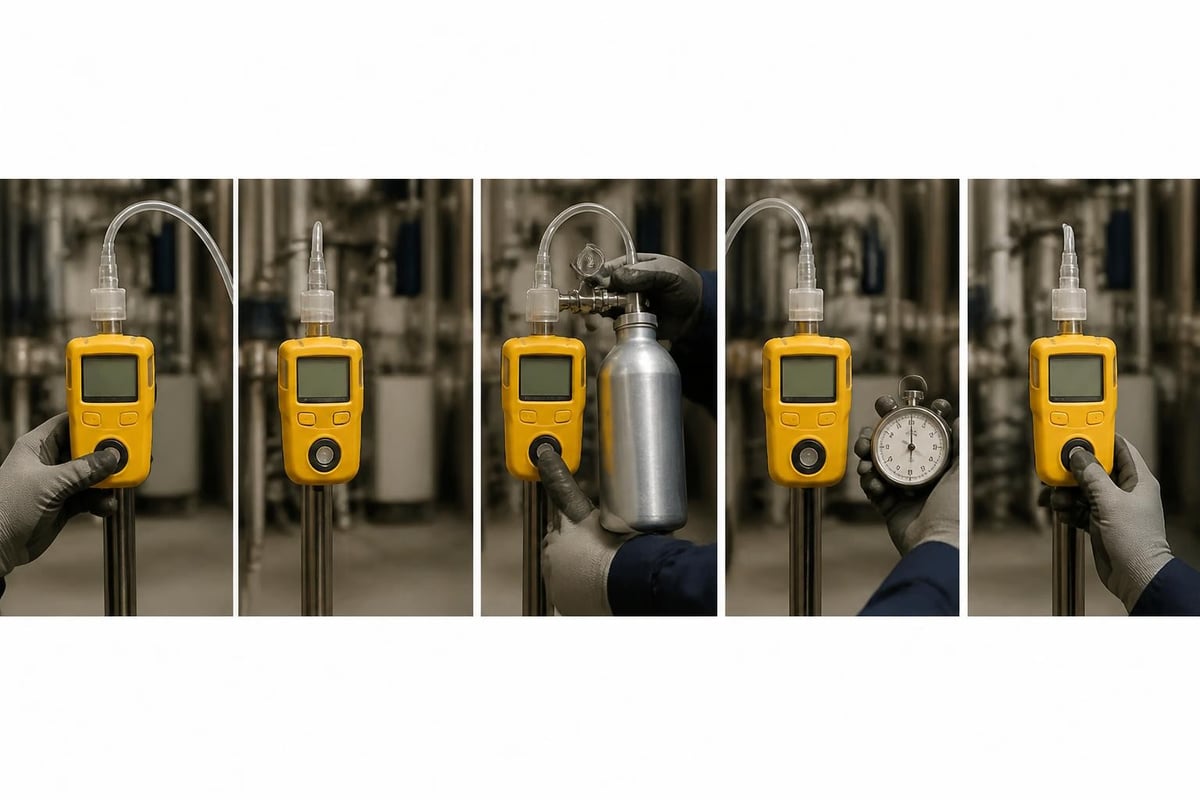
How do you run a calibration check, step by step?
- Check the cylinder label: gas, concentration, balance gas, lot and expiry date. Keep the certificate with the record.
- Start the detector in clean air and let it stabilise. Zero it in clean air, or in nitrogen where the manual says so.
- Fit the regulator and tubing to the cylinder. Use the regulator and flow the manufacturer specifies, because the wrong flow gives a wrong reading.
- Connect the calibration cap or cup, open the flow, and wait for each sensor to stabilise.
- Compare the reading with the cylinder value. Accept it if it is within your limit, for example ±10 %.
- If it is outside, run the full calibration (span adjust), then repeat the check.
- Remove the gas, let the readings clear, and record the as-found and as-left values.
Worked example: a 25 ppm H2S cylinder reads 22.0 ppm on the detector. The error is (22.0 – 25) / 25 = -12 %. That is outside a ±10 % limit, so the sensor needs a full calibration, even though it would pass a ±20 % limit. Decide your limit in advance, and set it tighter than the alarm margin that protects people.
What can go wrong?
- Expired or faded gas: the true concentration is no longer what the label says, so the span adjustment is wrong by an unknown amount. If the gas has faded, the detector over-reads and gives false alarms, and the calibration record cannot be trusted.
- Wrong regulator or flow: too little flow dilutes the sample with air and reads low.
- Long or absorbent tubing: reactive gases stick to some materials, so use short tubing of the type the manufacturer recommends.
- Cross-sensitivity: other gases can trigger a sensor. Check the manufacturer’s cross-sensitivity table before testing in mixed atmospheres.
- Wet or contaminated calibration cap: clean or replace it.
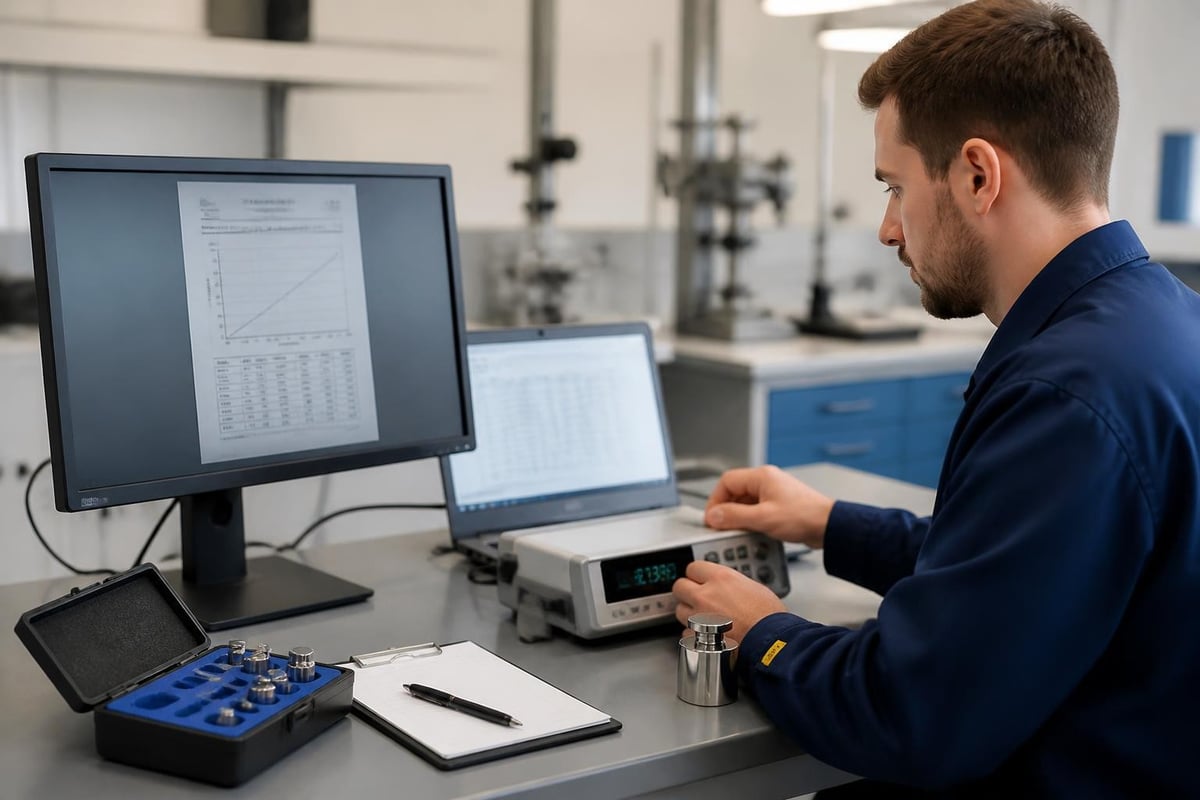
How do you show the gas is traceable?
Buy from a supplier that issues a certificate of analysis stating the concentration, uncertainty, balance gas, lot and expiry, and that links the value to national standards. NIST describes how traceable gas mixtures are built on SRMs, NTRMs and protocol gases. Record the certificate number with each calibration so an auditor can follow the chain. Read how to read a calibration certificate for the fields to check, and calibration, verification and adjustment for the terms.
Where can you find gas detectors and calibration equipment?
Browse gas detectors, and see portable vs fixed gas detection for process plants if you are choosing. Our guide on how to choose calibration tools for industrial engineers covers the wider toolkit, and the full catalogue lists the rest.
See the range at IndoMultiMeter. Orders ship worldwide.
Frequently asked questions
Can I use expired calibration gas?
No. Reactive gases change concentration over time, so an expired cylinder can set the sensor to the wrong target. A faded cylinder makes the detector over-read, and the calibration cannot be trusted. Use a cylinder within its date.
What is the difference between a bump test and calibration?
A bump test is a brief exposure that confirms the sensors respond and the alarms trigger. A calibration check measures the reading against a traceable concentration, and a full calibration adjusts zero and span.
How often should a portable gas detector be tested?
ISEA recommends a bump test or full calibration before each day’s use, and says that where less frequent verification is justified, the interval should not exceed 30 days. Follow the manufacturer manual and your site procedure, which may be stricter.
Why does the LEL basis matter for a methane cylinder?
Methane is quoted at 5.0 % by volume in some practice and 4.4 % in other standards. A 2.5 % methane cylinder equals 50 % LEL on the first and about 57 % LEL on the second, so the detector and certificate must use the same basis.
Which calibration gas shelf life is shortest?
In Industrial Scientific’s chart, NO2 is 4 months and Cl2 is 7 months, against 28 months for methane, O2, CO and CO2. In a combination cylinder, the shortest shelf life governs.