
Test & Measurement Blog · 16 Oct 2026
ECal Module vs Mechanical Cal Kit: Which Do You Need?
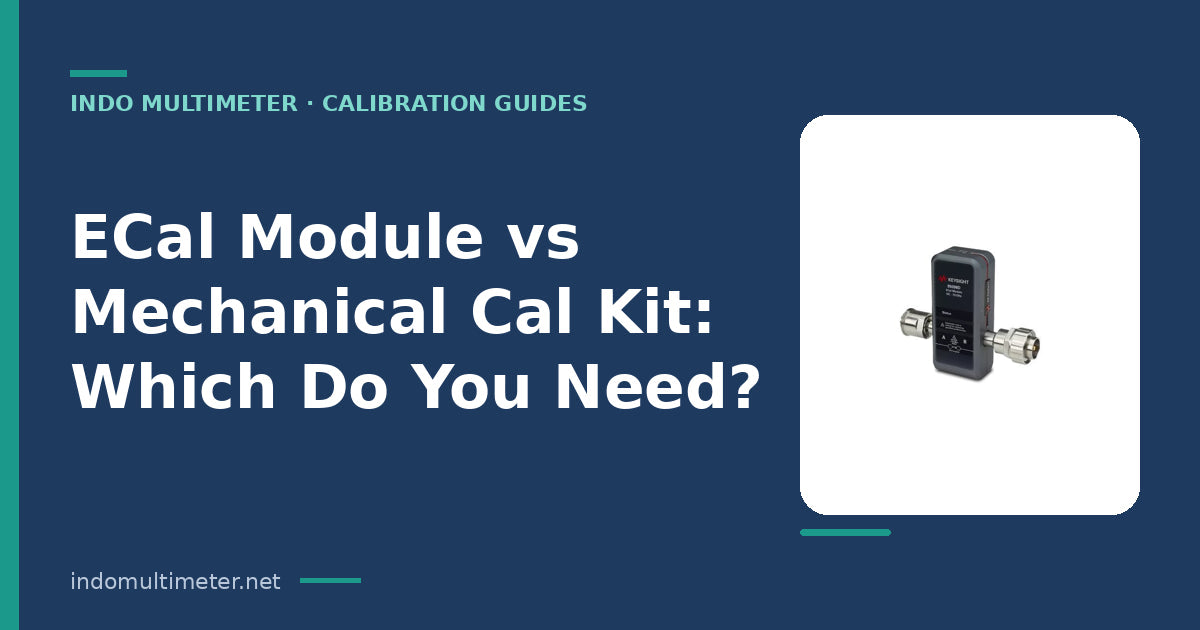
Choose an electronic calibration (ECal) module if you calibrate a vector network analyzer (VNA) often, at several ports, or with devices that cannot be connected back-to-back. Choose a mechanical kit if you calibrate rarely, need a simple type-N setup, or want a standards-based reference you can inspect. Many RF labs keep both, plus a separate verification kit.
How the two approaches differ
A VNA must be calibrated at the plane where the device under test (DUT) connects. The analyzer then removes its systematic errors (directivity, source match, load match, tracking) from every measurement.
A mechanical calibration kit does this with separate precision standards that you connect one at a time to each test port. Keysight describes its 85054D kit as containing precision standard devices that characterize the systematic errors of Keysight network analyzers in the type-N interface. You fit each standard by hand, tighten it to the specified torque, and let the analyzer step through the measurements.
An ECal module does the same job with a solid-state, electronically switched device. You connect it once, and the analyzer drives it over USB. According to Keysight, the module acts as a transfer standard that carries factory calibration accuracy to the analyzer, and its calibrations are NIST-traceable.
Keysight states that a full two-port ECal takes less than half the time and fewer connections than a mechanical kit, and that accuracy is comparable between the two methods. That is the manufacturer’s claim, not a figure we measured. Treat it as a reason to evaluate ECal, then check your own measurement uncertainty budget.
Keysight models compared
The table lists three Keysight products we can supply and one verification kit. Every entry comes from Keysight’s own product pages.
| Model | Type | Frequency coverage | Connector | Control / contents |
|---|---|---|---|---|
| 85098D | RF ECal module, 2-port | 300 kHz to 7.5 GHz | 7-16 listed; mixed options of 3.5 mm, 50 Ω Type N and 4.3-10 are mentioned on the page | USB control from PNA, ENA, PXIe and Streamline series analyzers |
| N7551A | Economy ECal module, 2-port | DC to 6.5 GHz | 3.5 mm or Type-N, both 50 Ω | USB 2.0 micro; PNA-X, PNA, ENA, PXI VNAs and FieldFox handheld analyzers |
| 85054D | Economy mechanical kit | DC to 18 GHz | Type-N, 50 Ω | Standards for full two-port calibration, gender-change adapters, torque wrench; connector gauges ordered separately |
| 85051B | Verification kit | Not compared here | 7 mm | 10 cm airline, stepped impedance airline, 20 dB and 50 dB attenuators, with NIST-traceable data and uncertainties |
Two points stand out. First, the mechanical kit covers a higher frequency (18 GHz) than the two ECal modules shown, so frequency range alone can decide the question. Second, the N7551A is positioned by Keysight as an economy option with lower precision than its N44xx and N469x ECal families, so it is not interchangeable with a premium module when your uncertainty budget is tight.
When an ECal module is the better choice
High calibration frequency
If technicians recalibrate before every measurement session, the saved connections add up. Each manual connection is an opportunity for a torque error, a dirty interface or a mis-ordered standard. A single USB connection removes most of those steps. Keysight cites this reduction in operator interaction as a main benefit of ECal.
Less connector wear
Keysight notes reduced connector wear compared with mechanical kits. Mechanical standards and the analyzer’s test port connectors wear with every mating cycle. If your test ports are expensive to replace or sit inside a fixture, fewer mating cycles matter.
Non-insertable devices
A non-insertable device has connectors of the same gender, or an incompatible type, at its two ports, so you cannot simply connect the two test ports together for the thru step. Keysight lists simple calibration of non-insertable devices as an ECal capability. This is easier with a module that offers a suitable connector combination, which is why connector options matter when you order. See the Keysight 85098D RF ECal module for a 7-16 example, and confirm the exact connector configuration you need before purchase.
Production and shared benches
When several operators share one analyzer, ECal gives more consistent results than a procedure that depends on each person’s technique. Consistency is useful for audit trails, since the calibration steps are the same each time.
Handheld and field analyzers
The Keysight N7551A page lists FieldFox handheld analyzers among compatible instruments. A compact module that is small and light, as Keysight describes it, suits field work better than a case of loose standards. The Keysight N7551A economy ECal module is the model in this class.
When a mechanical kit still makes sense
Frequency coverage above the module range
If your work reaches 18 GHz in a type-N interface, the Keysight 85054D economy mechanical calibration kit covers DC to 18 GHz. The two ECal modules above stop at 7.5 GHz and 6.5 GHz. Other ECal families go higher, but they are different products.
Low use
For a bench that is calibrated a few times a month, the time saved by ECal may not justify the choice. A mechanical kit works with any procedure the analyzer supports. According to Keysight’s manual summary, the 85054D supports simple one- or two-port and thru-reflect-match (TRM) calibrations.
Inspectable, definable standards
With a mechanical kit, each standard is a discrete physical item that the analyzer models using stored definitions. Some labs prefer this because they can inspect the standards, gauge the connectors and trace the method step by step. An ECal module is more of a black box: you rely on its factory characterization and its recalibration cycle.
Care required
Mechanical kits are not maintenance-free. The 85054D ships with a torque wrench because correct torque is part of the method. Keysight says connector gauges are ordered separately, so budget for them if your procedure includes gauging. Damaged or contaminated connectors will degrade any calibration, ECal or mechanical.
Verification kits are a different job
A calibration kit corrects the analyzer. A verification kit checks whether the analyzer is performing within its specification after correction. Keysight describes verification kits as used to verify that a network analyzer is operating within its specified performance.
The Keysight 85051B 7 mm verification kit contains a 10 cm airline, a stepped impedance airline, and 20 dB and 50 dB attenuators, supplied with measurement data and uncertainties traceable to NIST. Keysight lists it for use with PNA series analyzers and with a Keysight 7 mm calibration kit. Note that it is 7 mm, so it does not match a type-N workflow without adapters.
This distinction mirrors the general principle in our post on calibration vs verification vs adjustment. Verification produces evidence. It does not change the instrument.
Selection checklist for procurement
- Frequency range. Match the highest frequency you will measure to the kit or module, with margin. Confirm on the manufacturer page.
- Connector type and gender. Decide the interface of your DUT and fixtures. For ECal, check the available connector options for the specific part number.
- Analyzer compatibility. Check that your analyzer family is on the supported list. The 85098D and N7551A pages name different families, including FieldFox for the N7551A.
- Calibration frequency. High frequency of use favors ECal. Occasional use favors a mechanical kit.
- Uncertainty requirement. Compare the module class against your uncertainty budget. Keysight positions the N7551A below its N44xx and N469x families in precision.
- Traceability documents. Ask what certificates accompany the item, and how the module or kit is recertified. This matters for accredited labs; see our overview of calibration equipment for ISO/IEC 17025 laboratories.
- Verification. Decide whether you also need a verification kit, and make sure its connector type fits your analyzer ports.
Recommended pairings
- Research or production lab, up to about 7 GHz, frequent calibration: an ECal module such as the 85098D, with a verification kit on a periodic schedule.
- Field engineer with a handheld analyzer, type-N or 3.5 mm: a compact module such as the N7551A, if its precision class meets your requirement.
- Type-N work up to 18 GHz, or a low-use bench: the 85054D mechanical kit, with gauges and a clean-connector routine.
- Accredited calibration lab: both types, because a mechanical kit provides an independent cross-check of an ECal-based result.
You can browse the full range of analyzer calibration modules and kits to compare other frequency ranges and connector types. Send your analyzer model, frequency band and connector type to IMM, and we can confirm the compatible part numbers against the manufacturer’s data. For reference, Keysight’s own pages for the 85098D and the 85054D carry the complete product descriptions.
Frequently asked questions
Is an ECal module as accurate as a mechanical calibration kit?
Keysight states that accuracy is comparable between electronic and mechanical methods, and that ECal takes less than half the time and fewer connections for a full two-port calibration. The company does not give a numeric figure on its product page, so check the module's uncertainty data against your own requirement.
Can one ECal module calibrate any network analyzer?
No. Compatibility depends on the module. Keysight lists the 85098D for PNA, ENA, PXIe and Streamline series analyzers over USB, and the N7551A for PNA-X, PNA, ENA, PXI VNAs and FieldFox. Confirm your analyzer model against the manufacturer's page before ordering.
What does a Keysight 85054D mechanical kit include?
Keysight lists calibration standards for full two-port calibration, adapters to change the gender of the test port, and a torque wrench. Connector gauges are not included and are ordered separately. The kit covers DC to 18 GHz in a 50 ohm type-N interface and supports 1-port, 2-port and TRM calibrations.
Is a verification kit a replacement for a calibration kit?
No. A calibration kit lets the analyzer correct its systematic errors. A verification kit, such as the Keysight 85051B, checks that the analyzer is operating within specified performance after calibration. It contains airlines and attenuators with traceable data, and it does not adjust the instrument.
Need help specifying the right instrument?
Send us your application, range and accuracy requirements and our team will respond with a tailored quotation.