
Test & Measurement Blog · 27 Sep 2026
Complete Calibration Lab Setup: Essential Equipment Checklist
Building a Calibration Lab That Produces Defensible Results
Every calibration result is only as good as the equipment that produced it. A laboratory that cannot demonstrate traceability, environmental control, and documented procedures will struggle to defend its results in an audit, no matter how careful the technicians are. Setting up a calibration lab is a project, and the equipment list is longer than most people expect. This article walks through the complete calibration lab equipment checklist, from the reference standard at the heart of the lab to the fittings that connect it all.
The Reference Standard: The Heart of the Lab
Every measurement in the lab must trace back to a reference standard whose own calibration is traceable to international or national measurement standards. The reference standard is the equipment you trust most, and it sets the accuracy of everything else. For a pressure-focused lab that is a precision pressure standard, such as a deadweight tester or a high-accuracy digital pressure controller, backed by a calibration certificate. For temperature work it is a precision reference thermometer, typically a platinum resistance thermometer (PRT) with a readout. For electrical work it is a multifunction calibrator or standard instruments.
A reference standard is only a standard while its certificate is valid and its uncertainty is known. Track certificate expiry dates and schedule recalibration of the standards themselves; an out-of-date certificate quietly invalidates every calibration performed in the meantime. Budget more than half of your total investment for reference standards. Everything else in the lab exists to apply and compare against them.
Pressure Calibration Equipment
To calibrate pressure instruments you need both a pressure source and a pressure reference:
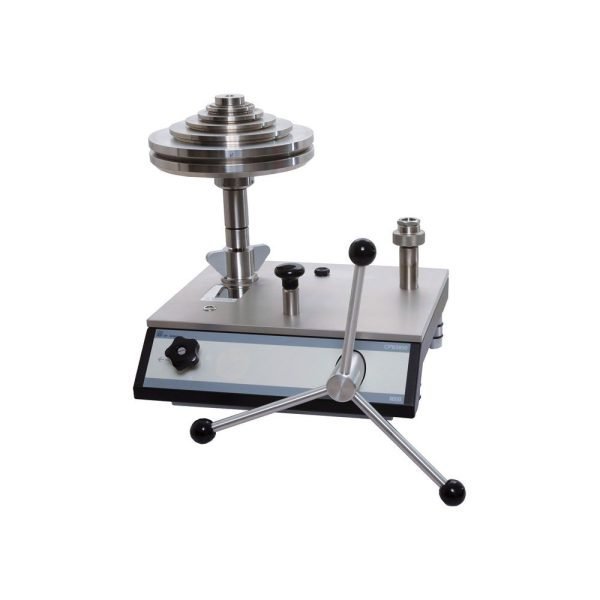
- Deadweight tester: the classic primary standard. Weights acting on a known piston area generate pressure with very high accuracy. Requires weights and weight sets matched to the tester.
- Pressure calibrator or controller: an electronic instrument that generates and measures pressure, often with a built-in pump or external pressure source.
- Hand pump or pressure source: for pneumatic and hydraulic ranges, to push the system to the test points.
- Digital pressure gauge or reference: for verification work where a deadweight tester is overkill.
Temperature Calibration Equipment
Temperature calibration requires generating a stable, known temperature and reading it with a trusted thermometer:
- Dry-block calibrator: a portable, practical heat source that holds inserts for different sensor diameters. Fast to set up, ideal for field and shop work.
- Temperature bath: a liquid bath for higher accuracy and stability. Slower to set up, but the reference choice when tight uncertainties matter. See temperature baths and chillers.
- Reference thermometer: a precision PRT or similar standard thermometer with a readout, used to measure the actual temperature in the source while calibrating the device under test.
- Thermocouple and RTD adapters: connectors that let you test the sensors actually used in your plant.
The general rule: dry-blocks are practical and portable; baths are more accurate and more stable. Choose based on the uncertainties you must meet.
Electrical Calibration Equipment
Most labs also calibrate electrical process instruments: transmitters, indicators, and loop-powered devices. Even if pressure and temperature are your main focus, almost every lab ends up verifying signal converters, indicators, and recorders, so a basic electrical calibration capability pays for itself quickly.
- Multifunction process calibrator: sources and measures mA, mV, V, and often temperature and frequency, covering transmitter and loop work.
- Loop calibrator: the workhorse for 4-20 mA work, able to source, measure, and simulate loop signals.
- Precision digital multimeter: for resistance, voltage, and current measurements with documented accuracy.
- Decade resistance box: useful for simulating RTD and resistance inputs during calibration.
Planning the Lab Space and Workflow
Before ordering equipment, plan the space. A calibration bench should be stable, well lit, and laid out so the workflow runs one way: receiving, pre-cleaning and inspection, temperature stabilization, calibration, documentation, and release. Dedicated areas keep standards away from the devices under test and from tools that could damage them. Think about access to power, compressed air for pneumatic work, and a sink or cleaning station for gauges that arrive covered in process residue. The room should be lockable and access-controlled, because reference standards are high-value assets that must not be borrowed for field work.
Environmental Control: Temperature and Humidity
Calibration results shift with the environment. A credible lab controls temperature and humidity because most instruments are affected by both:
- Room temperature control, ideally within a few degrees of the reference conditions stated in your procedures and certificates.
- Humidity monitoring and control, since moisture affects electrical leakage and some sensors.
- Records of temperature and humidity during calibrations, which auditors may ask to see.
- Stable bench and floor surfaces, away from direct sunlight, drafts, and vibration sources.
Storage, Handling, and Safety Equipment
Standards and weights are precision items that degrade when handled carelessly. Store weights in their cases, never stacked loosely, and handle them with gloves to avoid corrosion from skin contact. Keep deadweight testers and reference thermometers in dedicated, climate-controlled storage. Safety equipment belongs in the checklist too: pressure systems must have pressure relief protection appropriate to their rating, and technicians need eye protection and suitable PPE for hydraulic fluids and hot surfaces. Electrical work should follow the same rules as any energized testing, with insulated tools and proper procedures.
Documentation and Software
Equipment alone does not make a lab. Every calibration must be recorded, traceable, and reviewable:
- Calibration certificates for every standard, with validity dates and uncertainty statements.
- A calibration database or software for scheduling, recording as-found and as-left data, and generating certificates.
- Written procedures for each calibration type.
- An instrument register linking each device under test to its history.
- Uncertainty calculations, either in software or spreadsheets, for each calibration type.
Back up the calibration database regularly and keep archives of certificates, because auditors will ask for records that may be years old.
Fittings, Adapters, and Consumables
Calibration work fails or stalls on connections more often than on the standards themselves:
- Pressure fittings and adapters in the thread types you encounter: NPT, BSP, metric, and flare types.
- Hoses, couplings, and quick-connects rated for your maximum test pressure.
- Test leads, clips, and connectors for electrical connections, with insulation rated for the voltages involved.
- Spare inserts for dry-block calibrators in the sensor diameters you test.
- Calibration labels and tags to mark equipment status.
The Complete Calibration Lab Equipment Checklist
- Reference standards with valid, traceable calibration certificates.
- Pressure sources: deadweight tester or pressure calibrator, pump, and reference gauge.
- Temperature sources: dry-block and/or bath, with reference thermometer.
- Electrical calibrators: multifunction calibrator, loop calibrator, precision multimeter.
- Environmental control: temperature and humidity monitoring and control.
- Documentation: software, procedures, registers, certificate templates.
- Tooling: fittings, adapters, hoses, leads, and consumables.
- Storage: clean, climate-controlled storage for standards and weights.
- Safety: pressure relief, PPE, and safe handling procedures.
Equip Your Calibration Laboratory
Building a lab is an investment, and the equipment list above is the starting point for a defensible program. indomultimeter.net supplies the full range: calibration instruments, pressure calibrators, deadweight testers, weights and weight sets, temperature calibrators, temperature baths and chillers, and loop calibrators from Fluke, Druck/Baker Hughes, Additel, and other leading brands.
Planning a new lab or upgrading an existing one? Request a quotation and our team will help you build an equipment list that meets your accuracy requirements and your budget.