
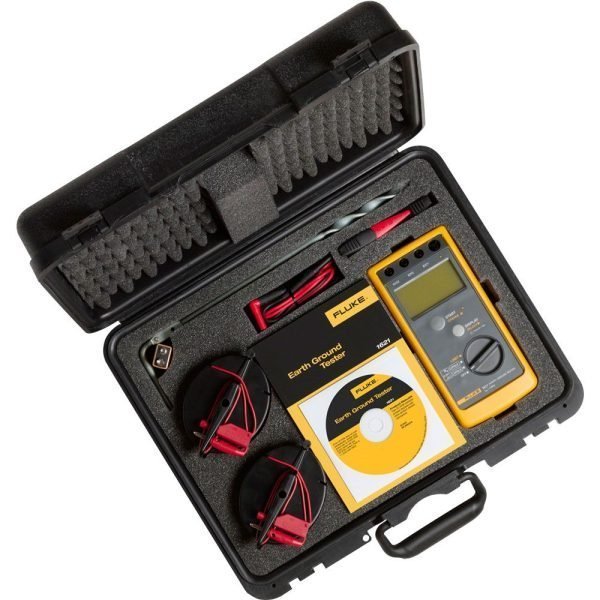
Fluke 1621: Key Findings
Earth ground testing does not need to be complicated. The Fluke 1621 KIT is Fluke’s entry-level ground resistance tester, built around the classic 3-pole Fall-of-Potential method, and it comes as a complete kit with stakes and leads. Here is how it holds up.
Fluke 1621 is the main subject of this practical guide. Use the information below to compare specifications, real-world fit, and limitations before making an equipment decision.
Overview
The 1621 performs 3-pole Fall-of-Potential and 2-pole ground resistance measurements in a handheld package with a large, clear LCD and a rugged holster. The KIT version adds the accessories you actually need in the field: test leads, auxiliary earth stakes, and a carry case.
What We Like
- True one-person operation. Single-button measurement concept; the display warns you if spike resistance is too high or conditions are invalid instead of giving a silently wrong number.
- Complete kit. Stakes and leads included – no separate accessory order before your first job.
- Size and toughness. Genuinely pocketable for a ground tester, with the usual Fluke holster protection.
- Clear LCD. Readable in direct sun, which matters when you are kneeling in a substation yard at noon.
Where It Falls Short
- No stakeless (clamp-on) testing – for multi-grounded systems you will want a Fluke 1625-2 or a clamp-on earth tester.
- No data logging or PC connectivity; results are read-and-record.
- 2-pole method accuracy depends on a known-good reference ground, which is not always available.
Who Should Use the Fluke 1621 KIT?
The Fluke 1621 KIT suits electricians, maintenance teams, telecom contractors, and facility engineers who need a straightforward way to verify earth electrodes and grounding connections. Its main strength is simplicity: the kit provides the tester, leads, and auxiliary stakes needed for a conventional field measurement, rather than requiring a separate accessory purchase before the first job.
Before testing, follow the site electrical safety plan and isolate equipment where required. The test method, probe spacing, soil conditions, and acceptance limit should come from the applicable standard, engineering procedure, or asset owner. A clear reading is not automatically a valid result if the stakes are poorly placed, the soil is unsuitable, or the test setup is affected by parallel grounding paths.
Fluke 1621 KIT Testing Workflow
A practical workflow includes visual inspection, identifying the electrode under test, placing the auxiliary stakes, checking lead connections, and repeating measurements when conditions are questionable. Record the date, weather or soil condition, probe layout, measured resistance, and any corrective action. For complex grounding networks, soil resistivity studies, or clamp-on testing, compare the 1621 with a more advanced earth-ground tester before selecting the instrument.
The Fluke 1621 KIT is therefore a good fit for routine electrode verification where the classic three-pole Fall-of-Potential method is appropriate. It is less suitable when the job requires stakeless measurements, automated data logging, advanced soil analysis, or a broader diagnostic feature set.
For repeatable results, keep the measurement layout and recording format consistent between visits. When the reading is unexpected, repeat the test after checking stake contact, lead continuity, and parallel paths before recommending corrective work.
Verdict
If your work is straightforward electrode verification – lightning protection, small substations, telecom cabinets – the 1621 KIT does the job with zero learning curve. Complex soil resistivity or stakeless work needs a bigger instrument, but that is not what this is for. Rating: 4/5.
See the Fluke 1621 KIT price and full contents.
Fluke 1621: Official Manufacturer Resource
For current specifications, compatibility, and product status, consult the official Fluke 1621 KIT information. Manufacturer documentation should take priority over third-party summaries when checking accuracy, operating limits, safety ratings, and included accessories.
Editorial note: This review was prepared by the Indo Multimeter Editorial Team for equipment research. Verify current specifications, availability, warranty, and manufacturer status before purchase.