
Test & Measurement Blog · 07 Sep 2026
pH Meter Calibration: Steps, Slope Limits and Buffers

For pH meter calibration, rinse the electrode, measure at least two fresh buffers that bracket your samples (for example pH 7 and pH 4), let each reading stabilise, and accept the calibration if the slope and offset are in range. Under USP <791> the limits are a slope of 90 to 105 % of theoretical and an offset within ±30 mV, with a third buffer used as a verification check. Repeat with fresh buffer if either value is out of range, and replace the electrode when cleaning no longer restores it.
What do slope and offset tell you?
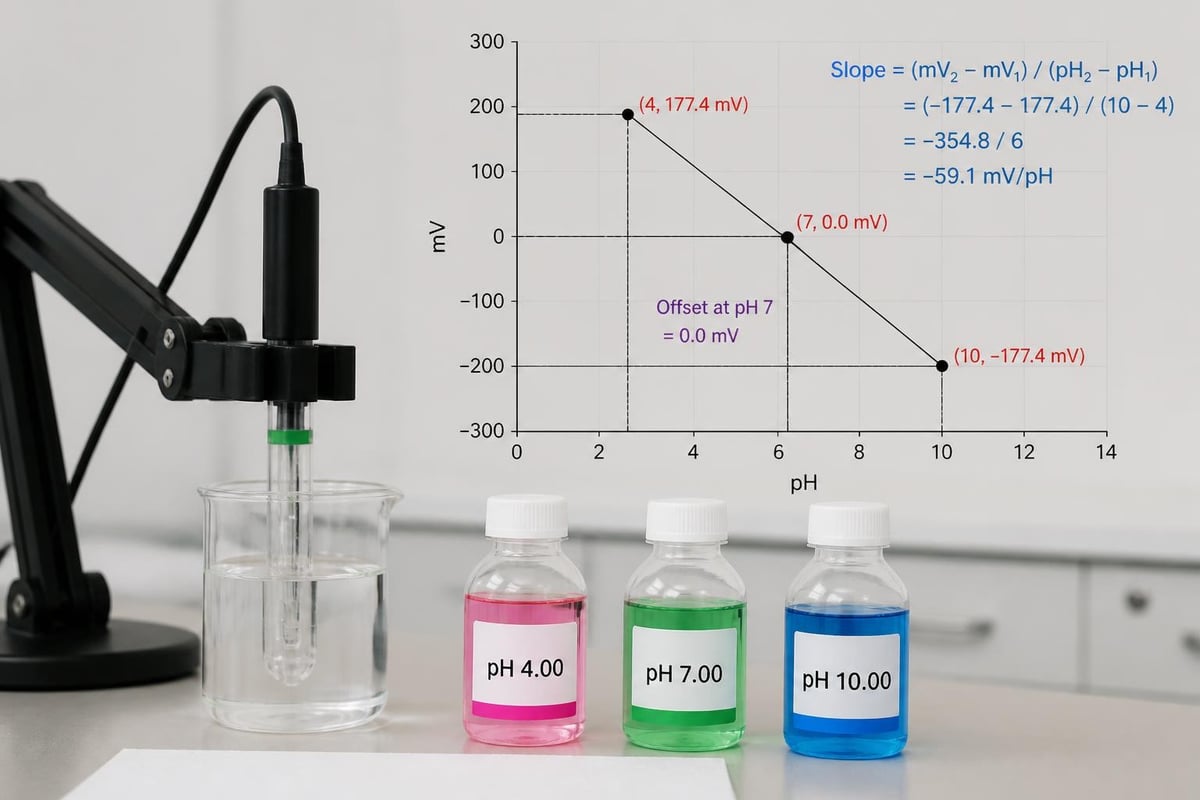
A pH electrode produces a voltage that changes with pH according to the Nernst equation. The theoretical slope is 59.16 mV per pH unit at 25 °C, and it scales with absolute temperature (about 0.1984 mV per kelvin per pH unit):
| Temperature | Theoretical slope |
|---|---|
| 10 °C | 56.2 mV/pH |
| 20 °C | 58.2 mV/pH |
| 25 °C | 59.16 mV/pH |
| 30 °C | 60.2 mV/pH |
| 37 °C | 61.5 mV/pH |
The offset (zero point) is the electrode voltage in pH 7 buffer, ideally near 0 mV. The slope is the measured mV change per pH unit, shown as a percentage of the theoretical value. Slope falls and offset grows as the glass membrane ages or gets coated. ICS Schneider’s article on assessing a pH electrode from the calibration lists the signs of ageing: decreasing slope, rising offset, longer stabilisation time, more drift and more frequent recalibration.
What are the acceptance limits?
| Source | Slope | Offset |
|---|---|---|
| USP <791> as summarised by Thermo Fisher | 90 to 105 % | within ±30 mV (0.5 pH at 25 °C) |
| Mettler Toledo guidance for in-line sensors | 95 to 102 % ideal; below 92 % suggests end of life | within ±30 mV at pH 7 |
Instrument and electrode makers publish their own windows, and ICS Schneider stresses that there is no universal limit, so judge the trend across calibrations. Follow your SOP and the manual for your meter.
Worked example: slope from a two-point calibration
At 25 °C, pH 7.00 should read 0 mV and pH 4.01 should read +176.9 mV (2.99 pH units x 59.16). Suppose the meter reads +6 mV and +180 mV.
- Span = 180 – 6 = 174 mV over 2.99 pH, so the slope is 58.2 mV/pH.
- Slope as a percentage of theoretical = 58.2 / 59.16 = 98.4 %: pass.
- Offset = +6 mV: within ±30 mV, pass.
Which buffers should you use?
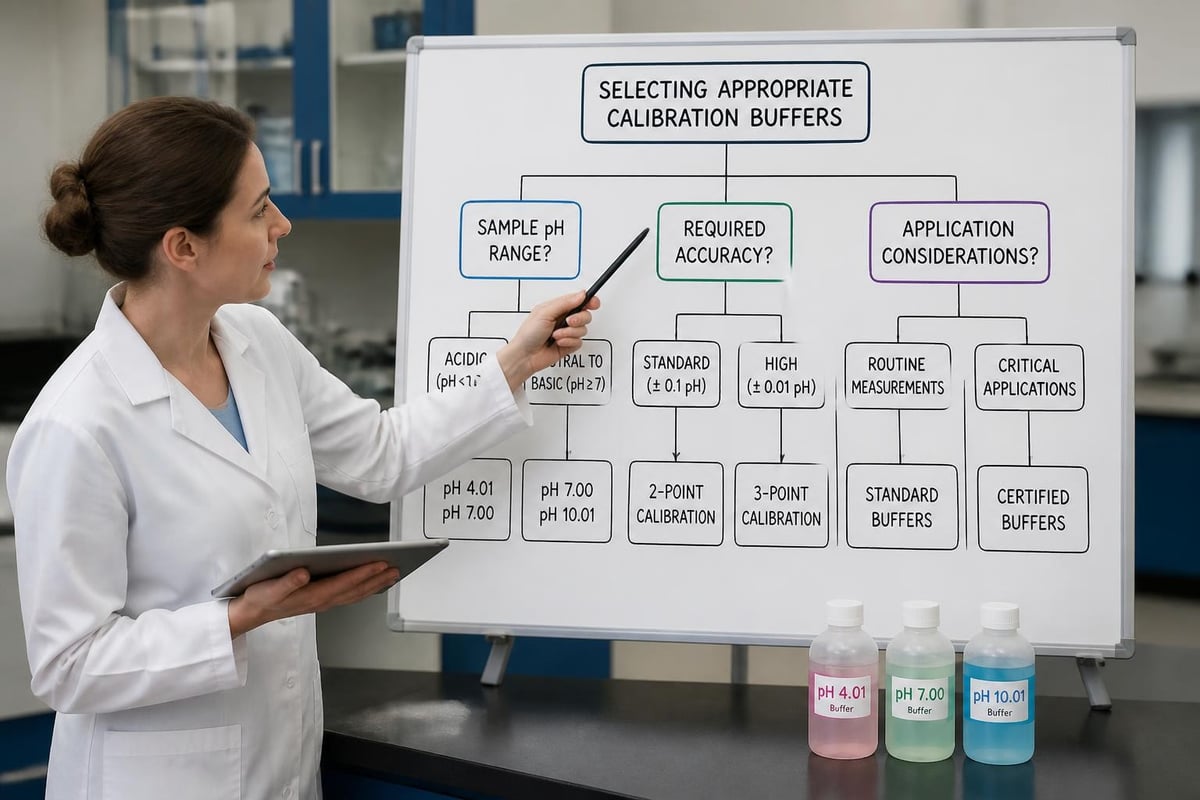
Choose buffers that bracket the pH of your samples. For samples from neutral to acidic, use pH 7 and pH 4. For neutral to alkaline, use pH 7 and a higher buffer such as pH 10. Thermo’s USP <791> guide suggests buffers not more than 3 to 4 pH units apart for optimum accuracy and notes that purchased buffers traceable to NIST with a stated accuracy of 0.02 pH may be used. Common sets are 4.01, 7.00 and 10.01 (US) or 4.01, 6.86 and 9.18 (DIN). NIST certifies the primary standards from which these are traced, at 25 °C:
| NIST SRM | Material | pH(S) at 25 °C |
|---|---|---|
| 188 | Potassium hydrogen tartrate | 3.557 |
| 185i | Potassium hydrogen phthalate | 4.005 |
| 186g | Phosphate pair | 6.864 (equimolal) and 7.416 |
| 187f | Sodium tetraborate (borax) | 9.195 |
The values come from NIST’s SRM table for pH calibration. The certificate is the only official source, so check it for uncertainty. Buffer pH changes with temperature, so use the value for the buffer temperature that the lot certificate gives, or let a meter with automatic temperature compensation apply the stored table.
How do you calibrate step by step?
- Check the electrode: clean membrane, filled reference electrolyte if refillable, no air bubbles or cracks.
- Warm up the meter, select the right buffer set and note the temperature.
- Rinse the electrode with deionised water and blot it. Do not rub the glass.
- Measure the first buffer (usually pH 7) with gentle stirring, and wait for a stable reading.
- Rinse, then measure the second buffer (pH 4 or pH 10) in the same way. Add a third buffer if your range is wide.
- Read the slope and offset. If they are in range, store the calibration.
- Measure a verification buffer that lies between the calibration buffers. Thermo’s guide gives an acceptance of ±0.05 pH for its USP <791> procedure.
Use fresh buffer, avoid carry-over, and never pour used buffer back into the stock bottle. One-point calibration only sets the offset, so use at least two points to determine slope.
Why does the calibration fail?
| What you see | Likely cause | What to do |
|---|---|---|
| Good slope, offset shifted | Reference junction or diaphragm, buffer conditions | Check the reference system and the buffers |
| Low slope, offset normal | Glass membrane coated or worn | Clean as the manufacturer instructs, recondition, recalibrate |
| Low slope and offset shifted | Advanced ageing or damage | Replace the electrode if cleaning does not help |
| Readings drift or fluctuate | Unstable electrode or contaminated buffer | Use fresh buffer, check temperature, check cable and connector |
ICS Schneider reports a case where cleaning improved the slope from -55.1 to -57.3 mV/pH and the offset from +15 to +8 mV, and also notes that calibration cannot repair a physically deteriorated glass membrane or an unstable reference system.
How often should you calibrate and what should you record?
Calibrate on the schedule your SOP sets, before critical measurements, after cleaning or replacing an electrode, and whenever a verification check fails. Record the date, operator, meter and electrode serial numbers, buffer lots and expiry dates, buffer temperature, slope, offset and the verification result. For the rest of the programme, see how often should instruments be calibrated and calibration, verification and adjustment, and how to read a calibration certificate for buffer and meter certificates.
Where can you find pH meters?
Browse pH and conductivity meters, for example the Cole-Parmer WD-35433-00 multi-parameter pH/conductivity/DO meter and the Cole-Parmer WD-35613-82 portable pH/ISE/mV meter. For process control, see process controllers.
See the full range of laboratory and field instruments at IndoMultiMeter, shipped worldwide, or browse the test & measurement catalogue.
Frequently asked questions
How many points do I need to calibrate a pH meter?
At least two, because one point only sets the offset and a second point is needed for the slope. USP <791> requires a minimum of two calibration buffers plus one verification buffer. Use three points when your samples cover a wide range.
What is an acceptable pH electrode slope?
USP <791> as summarised by Thermo Fisher accepts 90 to 105 % of theoretical, and Mettler Toledo describes 95 to 102 % as ideal and below 92 % as near end of life for its in-line sensors. Follow the limit in your SOP and your electrode datasheet.
Why does the slope change with temperature?
The theoretical Nernst slope is proportional to absolute temperature: 59.16 mV/pH at 25 °C and about 61.5 mV/pH at 37 °C. Automatic temperature compensation corrects the slope but not a real difference between the buffer and sample temperature, so keep both close.
Can I reuse calibration buffer?
Avoid it. Contaminated or carried-over buffer shifts the calibration. Use fresh buffer for each calibration, do not pour used buffer back into the bottle, and discard buffers past expiry.
When should I replace a pH electrode?
Replace it when the slope and offset stay out of range after cleaning and reconditioning, the response is slow or unstable, or the membrane or reference system is damaged. Calibration cannot repair a deteriorated membrane.