
Test & Measurement Blog · 12 Sep 2026
Fluke Process Meter: 787B vs 789, Specs and Uses
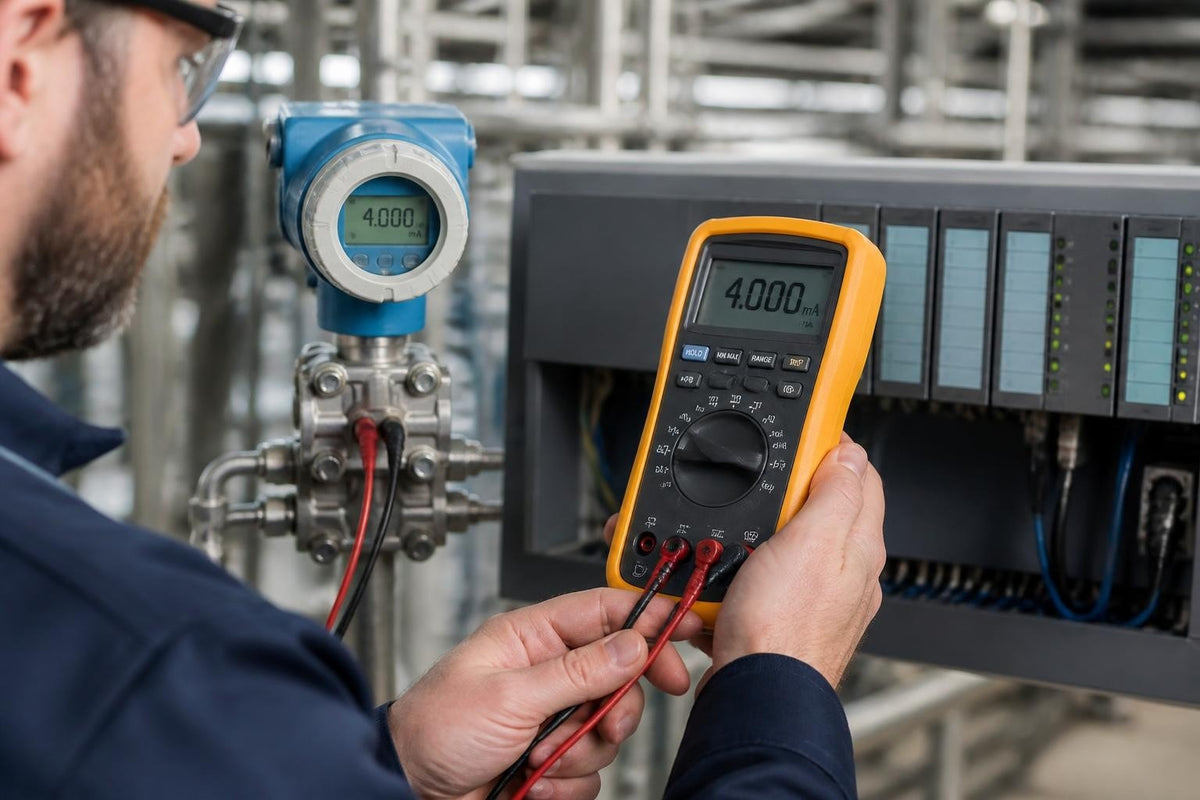
A Fluke process meter is a handheld digital multimeter with a built-in mA loop calibrator. It measures, sources and simulates 4-20 mA signals to check transmitters, PLC inputs and control valves, and it also does the usual DMM jobs such as voltage, resistance and frequency. The two current models are the Fluke 787B and the Fluke 789. Both specify mA accuracy as 0.05 % of reading + 2 digits on a 30 mA range, and mA output at 0.05 % of span. Figures below come from the Fluke product pages for the 787B and the 789.
What is the difference between the Fluke 787B and the 789?
| Specification | Fluke 787B | Fluke 789 |
|---|---|---|
| mA measure | 30.000 mA, 0.05 % + 2 LSD | 0 to 30 mA, 0.001 mA, 0.05 % + 2 LSD |
| mA source | 0 to 20 or 4 to 20 mA, 0.05 % of span, 24 V compliance (1,200 ohm at 20 mA) | 0 to 20 or 4 to 20 mA, 0.05 % of span, 24 V compliance (1,200 ohm at 20 mA) |
| mA simulate | 0.05 % of span, 1,000 ohm at 20 mA, external 15 to 48 V loop supply | Listed as a function; see the data sheet |
| Loop power | Powers the loop while measuring, per Fluke | Built-in 24 V loop supply, and a 250 ohm HART resistance can be added to the loop |
| DC voltage | 400 mV to 1,000 V, 0.1 % + 1 | 0 to 1,000 V, 0.1 % + 1 LSD |
| Resistance | 400 ohm to 40 Mohm, 0.2 % + 1 | To 40 Mohm, 0.2 % + 1 LSD |
| SpanCheck | Manual and automatic modes: coarse, fine, 25 % and 100 % steps, slow and fast ramp | 0 % and 100 % buttons toggle 4 and 20 mA, plus manual step, auto step and auto ramp |
| Safety | CAT IV 600 V / CAT III 1,000 V | CAT IV 600 V / CAT III 1,000 V |
| Operating temperature | -20 to 55 °C | -20 to 55 °C |
Choose the 789 when you need the built-in 24 V loop supply and the 250 ohm HART resistance. The 787B suits work where the loop already has a supply or where you want to simulate a transmitter with an external 15 to 48 V source. You can compare both against the dedicated Fluke 707 loop calibrator, which is accurate to 0.015 % + 2 digits but has no multimeter functions.
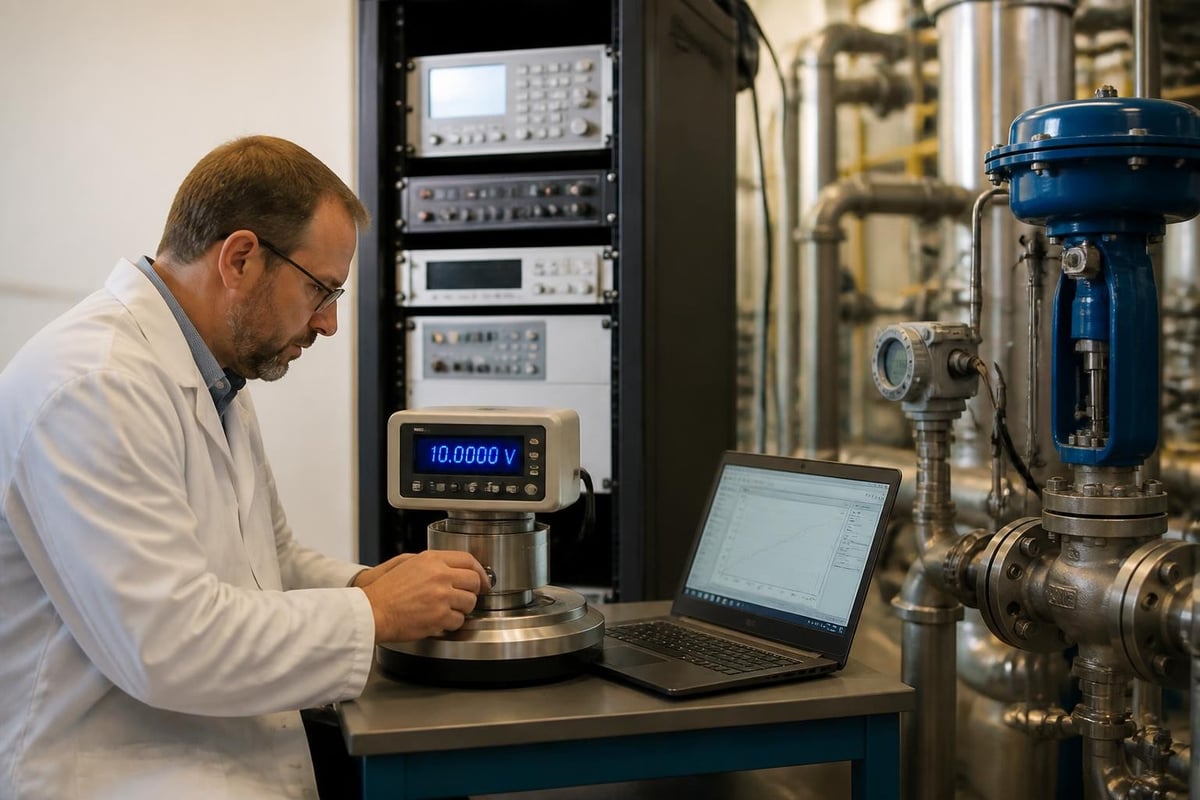
How accurate is it on a 4-20 mA loop?
On the 30 mA range the resolution is 0.001 mA, so 2 LSD is 0.002 mA. At the mid-point of a 4-20 mA loop:
| Mode | Error at 12 mA | As % of 16 mA span |
|---|---|---|
| Measure mA | 0.05 % x 12 mA + 0.002 mA = ±0.008 mA | ±0.05 % |
| Source mA (0.05 % of span) | 0.05 % x 16 mA = ±0.008 mA | ±0.05 % |
With a test uncertainty ratio of 4:1, that is enough to verify a transmitter with a tolerance of about ±0.2 % of span or looser. Fluke states the accuracy for 18 to 28 °C for one year after calibration. Outside that band the temperature coefficient is 0.05 x the specified accuracy per degree C. In a hot plant at 40 °C, 12 °C above the band, the accuracy grows by 0.05 x 12 = 60 %, so 0.05 % becomes about 0.08 %. Allow for that in your uncertainty budget when working outdoors in the heat.
How do you use it to check a transmitter or a control loop?
- Make the loop safe: put control in manual or bypass.
- Measure the signal: connect in series, measure mA and read the percent of span display against the control room indication.
- Power a bench transmitter: use the loop power function (789) to power and read it at once without a separate supply.
- Source into an input: source 4, 8, 12, 16 and 20 mA with the 25 % steps and compare with what the PLC or DCS shows.
- Stroke a valve: use the slow or fast ramp, or the step output, to move a valve or positioner smoothly.
- Simulate a transmitter: with an external 15 to 48 V supply (787B), set a current and test the wiring and the control system.
For the full routine with worked tolerances, read how to calibrate a 4-20 mA transmitter and loop testing tools and techniques.

How do you work with HART devices?
HART communication needs a minimum loop resistance, which the 789 can provide with its 250 ohm resistance setting. The process meter does not read the digital HART variables itself, so you still need a communicator to configure the device. Read what a HART communicator does, and see our Fluke 754 guide if you want HART communication in the same tool. When the process meter drives a HART loop, remember that the source drive capability falls as resistance is added. Do the arithmetic: a 250 ohm load at 20 mA drops 5 V, and the 789 has 24 V compliance.
How do you troubleshoot a bad loop reading?
- Reads 0 mA: open circuit, blown fuse or dead supply. Check wiring and supply first.
- Supply voltage too low: the supply must cover the transmitter minimum voltage plus the drop across all loop resistance at 20 mA.
- Reads over 20 mA: NAMUR NE 43 treats 21 mA or more as a failure signal, and 3.6 mA or less as a low failure signal. Check the transmitter datasheet for its actual alarm levels.
- Noisy or unstable: look for ground loops, shield terminations and nearby motor drives.

What safety rating matters?
Both meters are rated CAT IV 600 V and CAT III 1,000 V under IEC 61010, so you can use them for voltage checks in the electrical installation as well as on the loop. The maximum voltage between any jack and earth is 1,000 V RMS on the 787B. Keep the test leads in good condition and use only the leads the meter is rated for.
Where can you find process meters and related tools?
- The Fluke 787B ProcessMeter and Fluke 789 ProcessMeter are in the catalogue.
- For reading loop current without breaking the loop, see the Fluke 773 milliamp process clamp meter, or the Fluke 376 VIP clamp meter for AC and DC current.
- For the process input, use a pressure standard such as the Mensor CPC4000 psia, the CPC4000 psig or the Fluke 9143-B-P-156 precision pressure calibrator.
- Browse the full range of test and measurement instruments.
See the whole range of calibration equipment at IndoMultiMeter. Orders ship worldwide.
Frequently asked questions
What is a Fluke process meter?
It is a handheld digital multimeter combined with an mA loop calibrator. It measures, sources and simulates 4-20 mA signals and also measures voltage, resistance and frequency. The models are the Fluke 787B and Fluke 789.
How accurate is the Fluke 789 on mA?
Fluke gives 0.05 % of reading + 2 LSD for mA measurement on the 0 to 30 mA range with 0.001 mA resolution, and 0.05 % of span for mA sourcing. At 12 mA that is about ±0.008 mA.
Can a Fluke process meter power a transmitter?
Yes. The 789 has a built-in 24 V loop supply, so you can power and read a transmitter at the same time. The 787B can measure while powering the loop, per Fluke, and simulate a transmitter from an external 15 to 48 V supply.
What load can it drive in source mode?
Both models specify 24 V compliance, or 1,200 ohm at 20 mA. A 250 ohm HART resistance in the loop drops 5 V at 20 mA, which is well inside that.
Does a process meter replace a HART communicator?
No. It handles the analog 4-20 mA signal and can provide the 250 ohm resistance a HART communicator needs, but the digital HART values are read with a separate communicator or a calibrator with HART built in.