
Test & Measurement Blog · 10 Aug 2026
FLIR T865 Thermal Imaging Camera: Specs and Buying Guide
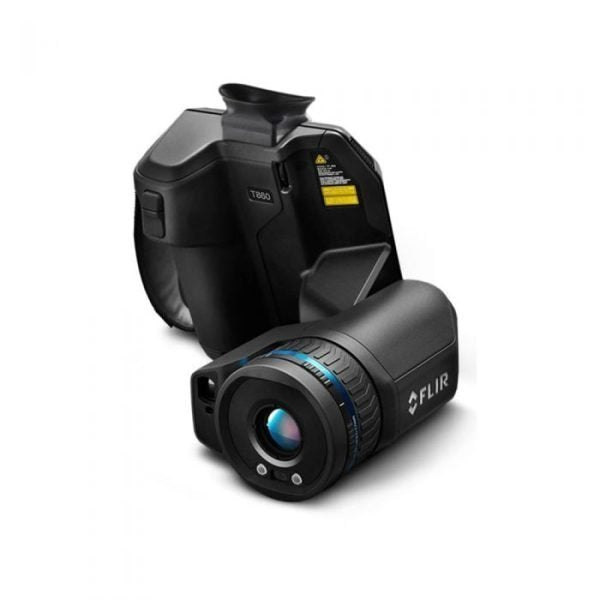
The FLIR T865 is a 640 x 480 handheld thermal camera for professional condition monitoring. It has a 12 µm uncooled microbolometer, thermal sensitivity under 30 mK with the 42° lens, a 180° rotating optical block and object temperature ranges from -40 to 2000 °C. FLIR specifies accuracy as ±2 °C or ±2% of reading. It suits teams that run route-based infrared surveys of electrical and mechanical assets. Teams that scan only occasionally should compare a fixed-lens camera first.
What are the FLIR T865 specifications?
The figures below come from the FLIR product page. Check the datasheet for your lens and configuration before you write them into a purchase specification.
| Parameter | Specification |
|---|---|
| IR resolution | 640 x 480 pixels |
| Detector | Uncooled microbolometer, 12 µm pitch, 7.5 to 14.0 µm |
| Image frequency | 30 Hz |
| Thermal sensitivity (NETD) | Under 30 mK (42° lens), under 40 mK (24° lens), under 50 mK (14° lens), at 30 °C |
| Object temperature ranges | -40 to 120 °C, 0 to 650 °C, 300 to 2000 °C |
| Accuracy | ±2 °C or ±2% of reading |
| Focus | Continuous or one-shot laser distance meter, one-shot contrast, manual |
| Display | 4 inch 640 x 480 touchscreen, plus integrated viewfinder |
| Visual camera | 5 MP with LED lamp |
| Storage and links | SD card (8 GB included), USB Type-C, Wi-Fi, Bluetooth |
| Battery | Li-ion, about 4 hours at 25 °C and typical use; two batteries in the box |
| Operating temperature | -15 to 50 °C |
Which lens should you choose?
The lens sets how small a target the camera can measure at a given distance. FLIR lists focal length and, for some lenses, the instantaneous field of view (IFOV). The remaining IFOV values below are calculated as detector pitch divided by focal length (12 µm / focal length), which reproduces FLIR’s stated 1.2 mrad and 0.7 mrad. Pixel size on the target is IFOV times distance.
| Lens | Focal length | Minimum focus | IFOV | Pixel size at 10 m |
|---|---|---|---|---|
| 80° | 5 mm | 0.1 m | 2.4 mrad (calculated) | 24 mm |
| 42° | 10 mm | 0.15 m | 1.2 mrad | 12 mm |
| 24° | 17 mm | 0.15 m | 0.7 mrad | 7 mm |
| 14° | 29 mm | 1.0 m | 0.41 mrad (calculated) | 4 mm |
| 6° | 70 mm | 5.0 m | 0.17 mrad (calculated) | 1.7 mm |
As a rule of thumb, cover the target with at least 3 x 3 pixels to get a reliable temperature. With the 24° lens at 10 m that means a target about 21 mm across. A 42° lens needs about 36 mm. For overhead lines and substation equipment the 14° or 6° lens is the practical choice. For enclosed panels and close work, the 24° or 42° lens is easier. FLIR also lists dual field-of-view options (24° plus 14°, and 42° plus 24°).
How accurate is the T865?
The specification is ±2 °C or ±2% of reading. Some FLIR marketing text quotes accuracy as good as 1 °C or 1%, but the specification table gives the ±2 figures, so use those for planning. The camera spec is only one part of the result. Emissivity, reflected apparent temperature, distance and target size usually contribute more error than the camera does. Laser-assisted focus helps because a sharp image is needed for the pixels to represent the target, not the surroundings.
If you must document absolute temperatures, record the emissivity you set, the reflected temperature, the distance and the load state of the equipment. For trending, a consistent method matters more than the last degree of accuracy.
What is it good for?
- Electrical distribution surveys. Switchgear, bus ducts, breakers and joints, where small temperature differences between phases show a developing fault.
- Rotating machinery and mechanical assets. Bearings, couplings, drives and pumps on a baseline-and-compare schedule.
- Utilities and substations. Long lenses give usable pixel sizes at a safe working distance.
- Route-based programs. FLIR lists compatibility with FLIR Thermal Studio Suite, Route Creator and FLIR Ignite for reporting and inspection routes.
Where does it fall short?
- Cost. It is a capital purchase. A team that scans a few times a year may not use the interchangeable lenses or route features enough to justify it.
- Training and software. Good images do not replace correct emissivity settings, electrical safety procedures or a documented inspection route.
- Battery and climate limits. Battery life is about 4 hours at 25 °C, and the operating range starts at -15 °C. Plan spare batteries for long surveys and cold sites.
Which FLIR T865 configurations does IndoMultiMeter list?
Lens kits change the price and the use case, so match the configuration to the survey work. See the FLIR T865 with 24° lens, the FLIR T865 with 14° lens, the three-lens kit or the 42° configuration. For a lower-cost 640 x 480 option with a fixed lens, compare the FLIR E96. Browse the full thermal imaging range for other brands and resolutions. To confirm a configuration, send us your application and lens needs.
For current specifications, compatibility and product status, use the official FLIR page. Manufacturer documentation takes priority over any third-party summary, including this one.
Editorial note: prepared by the IndoMultiMeter Editorial Team from the FLIR specification linked above. It is not the result of bench testing by IMM.
Frequently asked questions
What is the resolution of the FLIR T865?
It has a 640 x 480 pixel infrared detector, which is 307,200 pixels. FLIR also lists an UltraMax mode that quadruples the pixel count through processing in its reporting software.
What temperature range does the T865 measure?
FLIR lists three object temperature ranges: -40 to 120 °C, 0 to 650 °C and 300 to 2000 °C. Accuracy is ±2 °C or ±2% of reading.
Which lens suits electrical inspections?
The 24° lens suits most panels and switchgear, with a 0.15 m minimum focus distance. Use the 14° or 6° lens for overhead lines and substations, where the distance is long and the target is small.
How long does the battery last?
FLIR gives about 4 hours at 25 °C ambient with typical use. The camera ships with two batteries and a charger, so a full-day survey usually needs a charging plan.
What software works with the T865?
FLIR lists compatibility with Thermal Studio Suite, Route Creator, FLIR Ignite, Research Studio and the Atlas SDK. Check the FLIR product page for the current software list.